The First Four Days: The Creation of the Universe: an Annotated Account, by Delmar Dobberpuhl
For this reason, this web site presents for you to cover your issue. We show you some referred books The First Four Days: The Creation Of The Universe: An Annotated Account, By Delmar Dobberpuhl in all types as well as themes. From common writer to the popular one, they are all covered to supply in this website. This The First Four Days: The Creation Of The Universe: An Annotated Account, By Delmar Dobberpuhl is you're hunted for publication; you just need to go to the web link page to show in this website then choose downloading. It will certainly not take often times to get one publication The First Four Days: The Creation Of The Universe: An Annotated Account, By Delmar Dobberpuhl It will certainly depend upon your net connection. Just acquisition and download the soft file of this book The First Four Days: The Creation Of The Universe: An Annotated Account, By Delmar Dobberpuhl
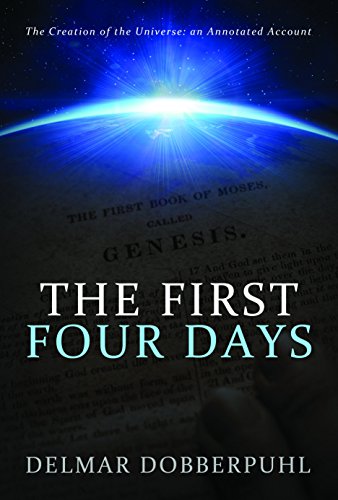
The First Four Days: The Creation of the Universe: an Annotated Account, by Delmar Dobberpuhl

Free Ebook PDF Online The First Four Days: The Creation of the Universe: an Annotated Account, by Delmar Dobberpuhl
Have you ever wondered what part (if any) science plays in the Genesis creation story? If so, The First Four Days was written for you. Physicist Delmar Dobberpuhl masterfully explains the scientific side of how God created the universe and rapidly matured it from Days 1 through 4 of the creation week. Instead of beginning with science and attempting to mold Scripture to fit it, Dobberpuhl starts his analysis with God’s Word and describes the scientific processes that were involved in each step of the creation and maturation of a perfect habitat for mankind. According to Webster’s New Collegiate Dictionary, science is “knowledge covering general truths or the operation of general laws especially as obtained and tested through scientific method.” As the author explains, the truths scientists have discovered about this world must be complementary and not contradictory to God’s Word. In his book, The First Four Days, Dobberpuhl fills in the details of the creating-and-making account (CMA) in Genesis with speculation that is based on complementary scientific theories and discoveries. Furthermore, he provides new insights and answers to questions about what God did during Creation week.
The First Four Days: The Creation of the Universe: an Annotated Account, by Delmar Dobberpuhl- Amazon Sales Rank: #2578222 in eBooks
- Published on: 2015-03-25
- Released on: 2015-03-25
- Format: Kindle eBook

Where to Download The First Four Days: The Creation of the Universe: an Annotated Account, by Delmar Dobberpuhl
Most helpful customer reviews
5 of 5 people found the following review helpful. Ideas Packed as Dense as a Neutron Star By David Oberpriller This book is not an "easy read". Although it is not overly technical and contains no mathematics, it is very dense with ideas and scientific concepts. The organization of the book is well-executed and the language and explanations are very understandable. This makes it suitable for readers with a basic understanding of science. However, there are a number of issues with it.The scope of the book is a Biblical and scientific coverage of the first four days of the creation account in Genesis chapter 1 - and the coverage is very thorough. Rarely does a Creationist book go into such detail as this one. The first chapter is an introduction to the subject, Chapters 2-7 cover each of what the author calls "divine actions" that occurred on the first four days, and Chapter 8 is a summary with a brief account of Days 5 through 7. An appendix contains Dobberpuhl's paraphrased version of the Biblical creation account - which he refers to as CMA (Creating-and-Making Account) - with extensive notes on translation of words from the Hebrew. An endnotes section and a thorough index rounds out the book.Chapters 2-7 have a common outline starting with a description of the "divine action" (or miracle), moving on to consideration of the CMA verses and pertinent verses from other parts of Scripture, then to addressing scientific terms, building the CM model based on the "divine actions", and finishing with a summary of the chapter. The "divine actions" are specific miraculous activities that the Creator performs - one or two per day. (I like the term "divine action" and will continue to use it in this review.)Dobberpuhl is to be commended for the copious use of terms like "theoretically", "speculate", "assume", "infer", and related derivative words - these are a constant reminder that cosmogony is a field where much is not certain - and cannot be - because it is historical in nature. The use of "divine actions" is also a useful concept in organizing the CM model and provides a God-honoring foundation to the model.The book is actually an expansion of a paper by Dobberpuhl and two other authors that was published in 2007 [1]. In some ways, it is disappointing that the paper co-authors did not participate in authoring the book. The paper does provide a good background for the reader prior to reading the book (and is a recommended course of action especially since it is easily available on the Web). It should be noted that the paper did generate a Letter to the Editor response from Humphreys [2] which will be discussed later (and is also available on the Web).Chapter 1 of the book provides a succinct and useful definition of miracles (what Dobberpuhl refers to as "divine actions" throughout the book). The key to the definition is contained in the following quote:"The main point to remember is that mankind and their science cannot explain miracles when only natural processes and physical laws are assumed without any supernatural component being involved. In physical terms, miracles are identified by a supernatural change in one or more of the three basic components of the universe: space, material substance, and time. God created all three of these with his first command for the universe to come into existence (Genesis 1:1). These components are so basic to everything physical that exists that only God can change them." [3]The assignment of the "divine actions" to specific parts of the days of creation is not usually done in commentaries on Genesis 1, but is effective in this book. It allows a detailed, distinctive timeline of the events of the four days to be assembled into the CM model.There area a number of issues that the reader will need to notice - and should deal with and make his/her own decision on their plausibility. These, though they do not detract from the account of creation, call into question certain aspects of Dobberpuhl's CM model. These are dealt with, though not definitively, in the following paragraphs. As is true with any presentation of new ideas, there is further refining to be done.The CM model begins with a kind of "quark soup" before the formation of protons, neutrons, electrons, and photons - this is different than most standard creation models that assume water is the basic substance [4]. The non-existence of light is postulated as evidence that atoms (i.e., water) did not exist at the beginning of the CMA [5] (the way light and atoms interact is an interesting study [6], though I was unable to find support for Dobberpuhl's position that atoms could not exist without light photons). This further requires that the "heaven" and the "earth" of Genesis 1:1 were different than the "heaven" and "earth" that were specifically defined by God on Day 3 and this is reflected in the paraphrased version presented in the appendix [7]. This non-water original state is the primary objection expressed in Humphreys' response [2] to the original article [1]. As Humphreys states, the literal reading of Scripture and the successful predictions that he has made regarding the magnetic fields of the planets that he has made based on water as the original substance point toward a literal reading of "water". This is a valid objection that I believe needs further work to overcome.An interesting concept presented in Chapter 4 dealing with Day 2 and the formation of galaxies describes each galaxy as forming from a black hole that developed white holes essentially as a rupture in its event horizon [8]. This association of black holes and white holes does not appear to be backed by current theoretical descriptions of these phenomena. A white hole is, theoretically, the opposite of a black hole and the two can be (theoretically) associated with each other in one of two ways: the matter falling into a black hole comes out of a white hole in an alternate universe or the two are at opposite ends of a "wormhole" through the time-space continuum [9]. It is also worth noting that white holes are only theoretical - no evidence for their existence is currently known. Dobberpuhl goes on to use the rotational "flash" of a white hole at the center of the forming Milky Way galaxy as a possible source of the light at the dawn of Day 3 on Earth [10]. The plausibility of this explanation is left up to the reader, though more information on this suggested phenomenon could have been included.In the section of each chapter that describes other Biblical references to that chapters "divine action", frequent usage of Psalm 104 is made to provide Scriptural evidence for the CM model. The interpretation of these verses is very literal. A literal hermeneutic allows for a loosening of the interpretation in poetic passages to one that is not as literal - the psalms are definitely poetic. Although Psalm 104 is generally regarded as dealing with the creation account (see Morris [11], for example), an interpreter must exercise caution in not "over-interpreting" the details of the Psalm. The reader will need to decide how literally Psalm 104 can be taken.For these and, probably, other issues, anti-creationists will likely rip this book apart for alleged discrepancies with "known" science (admittedly, a general statement that can be made for just about any creationist book). However, the intended audience for this book is creationists who would like some further insights into the science behind the days of creation and its fit to Scripture - and are both perceptive in their reading and willing to do some work to understand the insights. It is a book for serious study and not for perusal by the casual reader.Despite these shortcomings, the book is an interesting read. Many of the ideas (remember it is dense with them) are fascinating insights that are worth consideration. In writing this review, I was forced to do a moderate amount of research and reading to better understand (and evaluate) some of the presented concepts. While I may not agree with some of them based on my research, my own knowledge was increased - a beneficial result. I do not recommend that the reader simply "read the book" as is often done with books. I recommend that the reader be willing and prepared to read the background material that I have suggested and to "interrupt" the reading with in-depth research to help form his/her own opinion on the concepts.-------------------ENDNOTES:[1] DeRemer, Frank, Mark Amunrud, and Delmar Dobberpuhl, "Days 1-4", Journal of Creation 21(3) December 2007, pages 69-76. (available electronically at [....])[2] Humphreys, D. Russell, "Just Plain Ordinary Water?", Journal of Creation 22(1) April 2008, pages 56-57. (available electronically at [....])[3] Pages 5-6.[4] Pages 17-19.[5] Page 23 and 47-48.[6] Anonymous, "Atoms and Light Energy", [....], accessed 7 April 2012.[7] Pages 182-183.[8] Pages 54-55 and 62.[9] Anonymous, "BLACK HOLES, WORMHOLES AND WHITE HOLES", [....], accessed 7 April 2012.[10] Pages 101-103.[11] Morris, Henry M. with Henry M. Morris III, The Treasures in the Psalms, Master Books, Green Forest, AR USA, 2000, pages 206-217.
0 of 0 people found the following review helpful. The First Four Days (Day1 to Day4) By Ned - Origins Activist ("NOA") Delmar Dobberpuhl has provided a detailed scientific account of the first four days (Day 1 to Day 4). He was a laser physicist and knows about light (Gen. 1:3)! Dobberpuhl has a Master’s Degree from the University of Missouri – Rolla.This book covers Astronomy, Geology, Zoology and Botany. He describes matter down to the quark level. Dobberpuhl calls Genesis chapter one a creating-and-making account (CMA). A helpful summary ends each chapter and an index appears at the end. The two dozen illustrations are a great heuristic aid. One graphic shows the large scale structure of multiple galaxies (p. 60). An appendix gives insight into Hebrew terms used in Genesis One such as “placed” nathan and “sea monsters” tanniyniym.Dobberpuhl compares the budding of Aaron’s rod (Num. 17:7-9) to the dawn of plants on Day 3, “We should not be surprised that God could make plants sprout and come to maturity in less than a day …” (p. 117). He describes plant symbiosis which is a true enigma from the evolutionary viewpoint (which came 1st the bees or the roses?). He covers legumes and bacteria, tree roots with fungi as well as the Yucca Moth (pp. 135-138). Dobberpuhl breaks down photosynthesis to the atomic level – truly an indication of an Intelligent Designer (pp. 131-134).Dobberpuhl combines aspects of Barry Setterfield’s (c decay) and Russell Humphreys’ (time dilation) proposals to deal with the distant starlight problem (how can the cosmos be young if the stars are B’s of light-years away?). According to NASA’s measurements, the Pioneer probe is slowing down too fast (p. 163). Humphreys claims that this is evidence that the center of the cosmos is not that far from Earth. Thus, the Big Bang is in Big Pain.Dark matter is really a contrived fix to avoid young galaxies (pp. 164, 165). There are quasars that appear as two separate images due to gravity lenses. Dobberpuhl says that this is consistent with time dilation and the slowing of light (pp. 166-169).We have not been able to reproduce granite in the lab. There is evidence that water was present when granite formed (pp. 108, 109). This is in line with the CMA (Gen. 1:9). Dobberpuhl comments on Job 38:4-11, “This pictures the crust of the Earth as the source [of the sea] with reservoirs in it as the places where the seawater formed” (p. 85).Plasma clouds may be as hot as 10M °K and pose a problem for evolutionary cosmologists. How can this intergalactic media (IGM) be billions of years old without an energy source to maintain such high temperatures? Also, the cosmic microwave background radiation (CMBR) does not exhibit the shadowing caused by nearby galaxies that the Big Bang would predict (pp. 70-72). Dobberpuhl has written a gripping exposition and I highly recommend it.
0 of 0 people found the following review helpful. God Said By Gary Slump Wonderful explanation
See all 3 customer reviews... The First Four Days: The Creation of the Universe: an Annotated Account, by Delmar DobberpuhlThe First Four Days: The Creation of the Universe: an Annotated Account, by Delmar Dobberpuhl PDF
The First Four Days: The Creation of the Universe: an Annotated Account, by Delmar Dobberpuhl iBooks
The First Four Days: The Creation of the Universe: an Annotated Account, by Delmar Dobberpuhl ePub
The First Four Days: The Creation of the Universe: an Annotated Account, by Delmar Dobberpuhl rtf
The First Four Days: The Creation of the Universe: an Annotated Account, by Delmar Dobberpuhl AZW
The First Four Days: The Creation of the Universe: an Annotated Account, by Delmar Dobberpuhl Kindle

Tidak ada komentar:
Posting Komentar