Shanghai 1937: Stalingrad on the Yangtze, by Peter Harmsen
To get rid of the trouble, we now give you the innovation to get guide Shanghai 1937: Stalingrad On The Yangtze, By Peter Harmsen not in a thick published file. Yeah, reading Shanghai 1937: Stalingrad On The Yangtze, By Peter Harmsen by on the internet or getting the soft-file just to read could be among the ways to do. You may not feel that reading a publication Shanghai 1937: Stalingrad On The Yangtze, By Peter Harmsen will work for you. However, in some terms, May people effective are those who have reading routine, included this sort of this Shanghai 1937: Stalingrad On The Yangtze, By Peter Harmsen
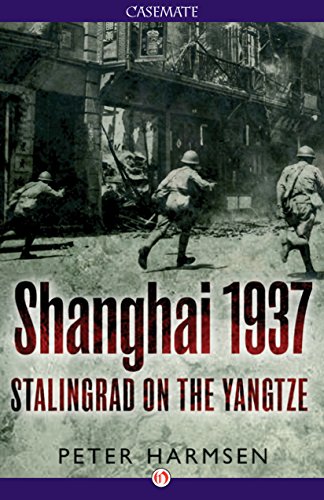
Shanghai 1937: Stalingrad on the Yangtze, by Peter Harmsen

Read Online and Download Ebook Shanghai 1937: Stalingrad on the Yangtze, by Peter Harmsen
This deeply researched book describes one of the great forgotten battles of the 20th century. At its height, it involved nearly a million Chinese and Japanese soldiers, while sucking in three million civilians as unwilling spectators—and often victims. It turned what had been a Japanese adventure in China into a general war between the two oldest and proudest civilizations of the Far East. Ultimately, it led to Pearl Harbor and to seven decades of tumultuous history in Asia. The Battle of Shanghai was a pivotal event that helped define and shape the modern world. In its sheer scale, the struggle for China’s largest city was a sinister forewarning of what was in store for the rest of mankind only a few years hence in theaters around the world. It demonstrated how technology had given rise to new forms of warfare, or had made old forms even more lethal. Amphibious landings, tank assaults, aerial dogfights, and—most importantly—urban combat all happened in Shanghai in 1937. It was a dress rehearsal for World War II—or, perhaps more correctly, it was the inaugural act in the war—the first major battle in the global conflict. Actors from a variety of nations were present in Shanghai during the three fateful autumn months when the battle raged. The rich cast included China’s ascetic Generalissimo Chiang Kai-shek and his Japanese adversary, General Matsui Iwane, who wanted Asia to rise from disunity, but ultimately pushed the continent toward its deadliest conflict ever. Claire Chennault, later of “Flying Tiger” fame, was among the figures emerging in the course of the campaign, as was First Lady Eleanor Roosevelt. In an ironic twist, Alexander von Falkenhausen, a stern German veteran of the Great War, abandoned his role as a mere advisor to the Chinese army and led it into battle against the Japanese invaders. Shanghai 1937 fills a gaping chasm in our understanding of the Second World War.
Shanghai 1937: Stalingrad on the Yangtze, by Peter Harmsen- Amazon Sales Rank: #70112 in eBooks
- Published on: 2015-10-20
- Released on: 2015-10-20
- Format: Kindle eBook
Review "Harmsen crisply narrates the battle, weaving together large unit movements and personal vignettes from mid-ranking officers and enlisted men. Clear maps illustrate each phase of the fighting, as do many fine photographs." --Journal of Military History, July 2015"More original than many works in Chinese, while also being much more readable... A moving and fluent narrative which describes a desperate and bitter battle in vivid prose." --Journal of Research of China's Resistance War Against Japan, June 2014"Peter Harmsen has produced an engaging and detailed work that will appeal to both general readers and specialists alike."--Journal of Chinese Military History "Mr Harmsen is an excellent writer. The book rattles along like a modern techno-thriller." --The Wargamer"'Shanghai 1937' has all the elements of a fabulous historical novel... Comparisons by online reviewers to Antony Beevor, author of 'Stalingrad' and 'Berlin,' are justly deserved." --Taiwan Today"What's special about this book is its comprehensiveness, shifting between Chinese, Japanese and foreign points of view.... Also uses the memoirs of numerous foreigners. In this respect it is richer than many works in the Chinese language." --Shenzhen Special Zone Daily"Engaging account of a little-known battle... practically nothing else in English tackles this topic at this level." --Stone and Stone"Dramatic documentary thriller... extremely high information and entertainment value." --Jyllands-Posten"I recommend it heartily. Even if you thought you knew all there was to know about the Second World War, if you haven't read up on the Sino-Japanese conflict, you've missed one of its principal roots." --PJ Media "The photographs included are fantastic, other editors would do well to look at how the selection has been made here... If you are looking to expand your world knowledge to the Middle Kingdom, have a look at this book." -- War History Online"Takes the casual reader as well as the avid military history enthusiast on a horrific journey down the blood-soaked alleys and warravaged suburbs of one of China's greatest cities... a must-read." --Sampan"Fills a huge historiographical void" -- Weekendavisen "Genuinely shines by interlacing the chronology with plenty of personal anecdotes and quotidian details... Exposes the banal cruelty of war, in the same vein as All Quiet on the Western Front." --City Weekend Shanghai "An engrossing study that goes far to fill the gap in the historiography of a neglected theater of operations and the first large-scale urban battle of the war." --Michigan War Studies Review"This book is meticulously researched, and vignettes are included from generals and privates alike... gives a sense of the battle's breadth and horror." --Military Heritage"Harmsen, a two-decade veteran of east Asia, demonstrates a breathtaking command of the battle itself - from the 10,000 meter, panoramic view of the terrain and history, down to the platoon level." - John D. Van Fleet, Asian Review of Books, 18 November 2013
About the Author Peter Harmsen, a foreign correspondent in East Asia for two decades, is the former bureau chief in Taiwan for the French news agency AFP.

Where to Download Shanghai 1937: Stalingrad on the Yangtze, by Peter Harmsen
Most helpful customer reviews
85 of 86 people found the following review helpful. Max Hastings of the Sino-Japanese War By Bavarian Bookworm Fans of accomplished writers such as Max Hastings and Antony Beevor will find much to like in this arresting and informative book about the outbreak of total war between China and Japan in 1937. This is not dry, old-school military history, but an attempt to show war as it was experienced by the participants, from the generals bent over their maps at headquarters, right down to the lowly “grunt” in the muddy trenches. Copious use of diaries and memoirs ensure that authentic voices permeate the entire narrative.The author does not shy away from showing the horrific aspects of modern war as it was unleashed on Shanghai during the battle. It is a depressing fact that civilians became victims from the very first day of the fighting, not just as a collateral damage, but because they were directly targeted by the Japanese invaders. Years of accumulated rage and hatred between China and Japan was let loose when war broke out between the two nations. If one wants to understand why memories of the war still linger in the collective minds of the two peoples even today, there is no better place to start than this book.One thing that surprised me as a German was the extent of the involvement of German officers in the early stages of the war against Japan. Originally sent to China as advisors to Chiang Kai-shek’s army, they became respected teachers to an entire generation of Chinese officers. Many of the Germans became deeply involved in the battle for Shanghai. This is a fact that is not often if ever mentioned even in German accounts of the years before and during the Second World War.
46 of 46 people found the following review helpful. Was this confrontation the beginning of WWII? By Dave Schranck Its popularly believed that WWII began in September 1939 when Germany invaded Poland but the author believes the beginning was actually in August 1937 when the Chinese Army was forced to attack the Japanese who were escalating their buildup on the mainland to free itself from the ever increasing menace of foreign domination. After you read this intriguing book you may agree with the author.Mr Harmsen, a foreign correspondent in China and the Far East for twenty years, has done a splendid job in recreating the events leading up to as well as the key events of this little known battle.This overview presents not only the strategic but also the tactical and human interest aspects of this nearly three month campaign that pitted the larger Chinese force against a well defended and motivated enemy with superior air and artillery support along with technological advantages. The Japanese also had a more coherent battle plan that along with the other advantages just mentioned would inflict huge losses on Chiang Kai-shek's best divisions and force them to give up on trying to retake this key city though partisan actions would continue, giving the Japanese little rest while they controlled the city.This battle story is infused and enhanced with many first hand accounts of leading officers, front line soldiers and civilians who were caught up between the warring sides. These individual accounts add to the appeal and truly enhance the overall readability of the story.I would have preferred greater tactical details on the order of a David Glantz presentation, yet I was still impressed with this book. The author has done a nice job of presenting the prewar background, main events of the three month urban struggle, many first hand accounts, post battle life in the city and the long term impact this battle had on the participants for the rest of the war and beyond.In addition to battle events, the author also presents a realistic description and appraisal of the flaws and virtues of command relationships and their decisions and the impact those decisions had on and off the battlefield. The combine package gives the reader a good overall understanding of the book.This book also has a few good maps, an Order of Battle, a decent Notes Section and a helpful Bibliography if you want to extend your research.If you have an interest in the Far East and how the antagonism between China and Japan grew into a major confrontation, this book will go a long way to inform and is recommended.
42 of 43 people found the following review helpful. Total War in Urban China By Daniel Jackson The Battle of Shanghai is oddly one of the best documented, but also least remembered battles from the period before America's entry into World War II. Peter Harmsen, in Shanghai 1937: Stalingrad on the Yangzi, seeks to makes use of the former to rectify the latter. Mr. Harmsen made use of a wide variety of sources, including from the Chinese and Japanese combatants, as well as from third-party observers in the International Settlement. The result is a nuanced and complex picture showing the horror of total war in one of the world's most populous metropolises. Harmsen does a great job moving from the politics at the top to the fighting man at the bottom. He builds a steady narrative that takes us through the battle as it develops. Of particular interest to me was the fact that Shanghai was a battle of Chinese choosing. In the wake of the Marco Polo Bridge Incident, Japanese armies swiftly occupied much of northeast China. Chiang Kaishek wanted to make a stand where his troops would have a tactical advantage. Given the Japanese superiority in tanks, aircraft, and artillery, urban combat in Shanghai gave his troops the best chance of success. Later, as the Japanese were clearly winning the battle, Chiang kept his troops in combat to try to generate sympathy on the global stage. One of the things I really appreciated about Harmsen's narrative is his demonstration of the brutality on both sides; the radicalization of the Japanese as they executed prisoners in gruesome ways and the Chinese, often civilians, that took brutal revenge when the opportunity presented itself. It is a grim picture of modern war. Shanghai 1937 will give the reader a new perspective on World War II in Asia and the Pacific. The text is accompanied by a good number of photographs and maps.
See all 108 customer reviews... Shanghai 1937: Stalingrad on the Yangtze, by Peter HarmsenShanghai 1937: Stalingrad on the Yangtze, by Peter Harmsen PDF
Shanghai 1937: Stalingrad on the Yangtze, by Peter Harmsen iBooks
Shanghai 1937: Stalingrad on the Yangtze, by Peter Harmsen ePub
Shanghai 1937: Stalingrad on the Yangtze, by Peter Harmsen rtf
Shanghai 1937: Stalingrad on the Yangtze, by Peter Harmsen AZW
Shanghai 1937: Stalingrad on the Yangtze, by Peter Harmsen Kindle

Tidak ada komentar:
Posting Komentar