Emperor Hirohito and the Pacific War, by Noriko Kawamura
When getting this e-book Emperor Hirohito And The Pacific War, By Noriko Kawamura as recommendation to review, you could gain not only inspiration however also brand-new knowledge as well as driving lessons. It has greater than common advantages to take. What kind of e-book that you read it will work for you? So, why should obtain this book entitled Emperor Hirohito And The Pacific War, By Noriko Kawamura in this short article? As in web link download, you could obtain the publication Emperor Hirohito And The Pacific War, By Noriko Kawamura by on-line.
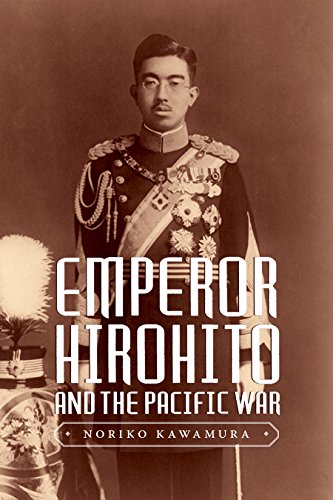
Emperor Hirohito and the Pacific War, by Noriko Kawamura

Free Ebook Emperor Hirohito and the Pacific War, by Noriko Kawamura
This reexamination of the controversial role Emperor Hirohito played during the Pacific War gives particular attention to the question: If the emperor could not stop Japan from going to war with the Allied Powers in 1941, why was he able to play a crucial role in ending the war in 1945? Drawing on previously unavailable primary sources, Noriko Kawamura traces Hirohito's actions from the late 1920s to the end of the war, analyzing the role Hirohito played in Japan's expansion. Emperor Hirohito emerges as a conflicted man who struggled throughout the war to deal with the undefined powers bestowed upon him as a monarch, often juggling the contradictory positions and irreconcilable differences advocated by his subordinates. Kawamura shows that he was by no means a pacifist, but neither did he favor the reckless wars advocated by Japan's military leaders.
Emperor Hirohito and the Pacific War, by Noriko Kawamura- Amazon Sales Rank: #1081923 in Books
- Published on: 2015-10-26
- Original language: English
- Number of items: 1
- Dimensions: 9.10" h x .90" w x 5.90" l, .0 pounds
- Binding: Hardcover
- 248 pages
Review
This is an eye-opening book.... Kawamura's research reveals the real Hirohito.--Geoffrey Wawro"History Book Club" (01/01/2015)
Review "Kawamura offers a novel perspective on the role of Emperor Hirohito in the Pacific War and in the years which preceded it. Based on new and reappraised sources, she draws a human portrait of him, different from the caricatures that have been presented until now."―Ben-Ami Shillony, The Hebrew University of Jerusalem
"This is a strong book. It sets out in careful detail the maneuvering in and about the emperor on the key issues of the war, and it comes to considered judgments."―Richard Minear, University of Massachusetts Amherst
About the Author Noriko Kawamura is associate professor of history at Washington State University. She is the author of Turbulence in the Pacific: Japanese-U.S. Relations during World War I.

Where to Download Emperor Hirohito and the Pacific War, by Noriko Kawamura
Most helpful customer reviews
2 of 2 people found the following review helpful. Important but Slow By Amazon Customer Emperor Hirohito has always been something of a mystery: was he a Japanese extremist embracing war and conquest or was he a lover of peace who did his best to control extremists and eventually bring the Pacific War to a close? Ms. Kawamura persuasively demonstrates he was neither. She admits he was not opposed to a predatory Japan, but he was opposed to a defeated predatory Japan. The author sees Hirohito as a prisoner of the Japanese system which made the Emperor both an absolute monarch and a figurehead. However, she gives insufficent weight to Hirohito's personal failings. Ambiguity favors strong personalities and the army was out of control in the 1930s : only decisive and perhaps brutal action to bring rebellious officers to heel would have had a chance of restoring discipline. Hirohito lacked the moral courage and perhaps the physical courage to make the attempt. In the run up to Pearl Harbor, he urged negotiations over war, but this was pointless unless Japan's apetite for conquest could be curbed so that negotiations might succeed. Hirohito was in a difficult position, but he failed both the world and his country. A minor irritant is Ms.Kawamura's frequent reference to "leftist" historians. Meaningless labels are of no help to readers and bring into question the author's objectivity. Reading this book is a chore, but one that should undertaken.
0 of 0 people found the following review helpful. The tricky question of responsibility By Michael R. Broschat Kawamura's Emperor Hirohito and the Pacific War is an important new look at some not so distant history. She examines the contention that if the Japanese emperor was seemingly able to stop the Pacific War then was he responsible for starting it?She looks at how Hirohito grew up and the values that were important to him as he did so. Foremost among them was a belief in "international accommodation." But at the same time, a militaristic jingoism flourished in Japan, and as so often happens with agressiveness, its presence became increasingly apparent within the governing circles of Japan. No small part of this movement was assassination. By the time the decision was made to involve the United States in Japanese military aggression, the vast majority of ruling voices belonged to militarists, opposing voices having retired or been assassinated. The emperor became a rubber stamp for actions taken by the governing council.But when it became clearer and clearer that Japan was on the way to ruin, even some in the militaristic camp began to look for a way out. The emperor was that way.Assassination continued right up to the end. A movement to steal the recording of the emperor surrendering was made before that famous broadcast, but an officer of the Imperial Guard betrayed the effort, and the rebels were contained.The emperor spoke only to a couple close associates after the war, and their notes are as close as the world ever got to hearing what Hirohito the man had to say about the role of emperor during the period of Japanese aggression. Kawamura uses this, too, among the many resources she consulted for this fine study.
1 of 2 people found the following review helpful. An Authoritative Reappraisal of a Complex, Controversial Emperor By Norm Haskett Noriko Kawamura’s “Emperor Hirohito and the Pacific War” provides a convincing, for me at any rate, reappraisal of Japan’s Hirohito few Westerners would recognize whenever they are reminded of Pearl Harbor and the Pacific conflict. This owes largely to Kawamura’s use on a huge number of primary and secondary Japanese-language sources—some of them only recently available to scholars. I’m referring here to diaries, letters, memoirs, and testimonies of people who served the Japanese emperor in a civilian, ministerial, or military capacity, as well as to imperial records, including those dictated by Hirohito himself; cabinet minutes and parliamentary papers; transcripts of postwar trial proceedings; and so on. Mining this treasure trove Kawamura has drawn what I believe is a fair, nuanced portrait of Hirohito who, in the first years his reign, confronted a passionate nucleus of mostly junior- and middle-level army officers hell-bent on advancing the military’s position against competing Japanese power centers. Over time the “overreach” of these extremists extended way beyond dominating every level of domestic affairs to laying violent claim to much of the Asian continent and the Pacific islands for their “new order.” Kawamura cites case after case where Hirohito was constitutionally bound to ratify the consensus reached by his military and civilian advisers to challenge Western powers that had colonial claims in Southeast Asia, even though the emperor was personally against the rush to war with the West. She portrays Hirohito growing ever more skeptical of a favorable military outcome as Japanese victories over the enemy proved more elusive by the month. Terrified by the prospect of “Japan’s annihilation,” as Hirohito himself put it, the emperor at last flexed his moral muscles in a set of imperial prerogatives (“seidans”), taking on the fire-breathers in the war faction to end the conflict. To his dying days in January 1989 the Hirohito of Kawamura’s account privately agonized over his not nipping in the bud the calamity that his pro-war military and their ultranationalist and financial supporters were poised to inflict both on his loyal subjects and on tens of millions more who would suffer, be injured or maimed, or lose their lives in the Pacific War.
See all 3 customer reviews... Emperor Hirohito and the Pacific War, by Noriko KawamuraEmperor Hirohito and the Pacific War, by Noriko Kawamura PDF
Emperor Hirohito and the Pacific War, by Noriko Kawamura iBooks
Emperor Hirohito and the Pacific War, by Noriko Kawamura ePub
Emperor Hirohito and the Pacific War, by Noriko Kawamura rtf
Emperor Hirohito and the Pacific War, by Noriko Kawamura AZW
Emperor Hirohito and the Pacific War, by Noriko Kawamura Kindle

Tidak ada komentar:
Posting Komentar