The Generals: Patton, MacArthur, Marshall, and the Winning of World War II, by Winston Groom
By visiting this web page, you have actually done the right looking point. This is your begin to select guide The Generals: Patton, MacArthur, Marshall, And The Winning Of World War II, By Winston Groom that you want. There are great deals of referred books to review. When you intend to get this The Generals: Patton, MacArthur, Marshall, And The Winning Of World War II, By Winston Groom as your publication reading, you can click the link page to download and install The Generals: Patton, MacArthur, Marshall, And The Winning Of World War II, By Winston Groom In few time, you have actually possessed your referred books as yours.
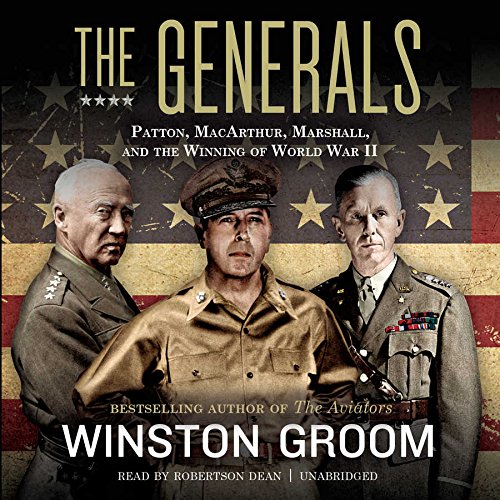
The Generals: Patton, MacArthur, Marshall, and the Winning of World War II, by Winston Groom

Ebook PDF Online The Generals: Patton, MacArthur, Marshall, and the Winning of World War II, by Winston Groom
Celebrated historian Winston Groom tells the intertwined and uniquely American tales of George Patton, Douglas MacArthur, and George Marshall-- from the World War I battle that shaped them to their greatest achievement: leading the allies to victory in World War II. These three remarkable men-of-arms, who rose from the gruesome hell of the First World War to become the finest generals of their generation during World War II, redefined America's ideas of military leadership and brought forth a new generation of American soldier. Their efforts revealed to the world the grit and determination that would become synonymous with America in the postwar years.
The Generals: Patton, MacArthur, Marshall, and the Winning of World War II, by Winston Groom- Amazon Sales Rank: #435788 in Books
- Published on: 2015-10-27
- Formats: Audiobook, MP3 Audio
- Original language: English
- Number of items: 1
- Dimensions: 7.60" h x 5.40" w x .60" l,
- Binding: MP3 CD
- 1 pages
About the Author Winston Groom is the beloved author of 14 previous books, including Forrest Gump; The Aviators; Conversations with the Enemy (nominated for a Pulitzer Prize); 1942: The Year That Tried Men's Souls; Vicksburg, 1863; and Shiloh, 1862.

Where to Download The Generals: Patton, MacArthur, Marshall, and the Winning of World War II, by Winston Groom
Most helpful customer reviews
34 of 34 people found the following review helpful. Interesting Life Stories of Three Great Generals by an Excellent Storyteller By Q. Publius Winston Groom is an excellent storyteller, whether he's writing fiction or nonfiction. His most recent books (The Aviators and this book) have been nonfiction histories. This book, on Generals George Marshall, Douglas McArthur, and George Patton, is an interesting narrative on the lives, careers, and accomplishments of these great American leaders. Each of these generals have been the subject of many biographies. One might ask why a book should be written, or why should a reader be interested in, a book that provides an overview of these generals' lives? For me the answer to these questions is that Groom has a knack for telling interesting stories that capture key features of a situation. Even though I have read many biographies of George Marshall, including the 4-voume official biography by Forrest Pogue, I learned new and interesting things about General Marshall from Groom's stories. Though I have not read as much about McArthur and Patton, Groom's stories left me feeling he had painted a penetrating picture of their lives and personas. The book starts with chapters on the early lives and careers of each of the three generals, then a chapter telling the story of their experiences in World War I--Marshall an outstanding planner on Pershing's staff, Patton as a senior tank officer, and McArthur as the fast-rising combat leader of the famous Rainbow Division. In later chapters the author follows their inter-war years, their World War II achievements, and their post-World War II careers. One might ask how Groom chose these three generals rather than others--Eisenhower, for example. He does not address this question, but there is no question that Patton is a more colorful character than Ike. Americans have always venerated those they considered "fighting generals" more than those who, like Eisenhower, were perceived as political or administrative generals. While Marshall was the ultimate political and administrative general in World War II, his role was so critical that Winston Churchill called him "the Organizer of Victory." It would have been even more questionable if Groom had not included Marshall in this book. This book is an interesting read and well worth reading. I rate it four stars, with one star taken off due to technical issues. For example, the Chapter on D-Day ("Overlord") goes into a narrative of the European campaign through German's surrender. Then the next chapter goes into a detailed description of the campaign from northern France into Germany. These two chapters would have flowed better if they had followed a more chronological order. Also, though it is important to note that I read an advance copy of the text that was by no means final, it was difficult to read in places due to editing or typesetting difficulties. Also, the footnotes may not have been finalized. While sources were cited, the page numbers were not, which would make it very difficult to find cited passages. In the larger scope of things, these technical issues do not prevent this book from being an excellent read for both those widely read in 20th century American military history and for those relatively new to this literature. One final note: the subtitle makes it sound like the period covered ends with World War II, but, for Marshall and McArthur, the story continues into Korea and their activities afterwards through the remainder of their lives.
16 of 16 people found the following review helpful. Excellent, well-written history. Interesting and a great narrative. By Narut Ujnat This was not initially a book that I wanted to read because I am pretty familiar (I thought) with the three generals discussed here. But I went ahead and read this book anyway.The author, Winston Groom, is the author of numerous books including Forrest Gump, which was a work of fiction. However, what I didn't know was Groom has written a number of popular works of history and these have typically been well-received.The narrative here is about three important generals. George Marshall, George Patton and Douglas MacArthur. What I really liked about this book is the approach of discussing their biographies and their background before the Second World war even broke out. I learned or was reminded of all kinds of interesting facts about these men. MacArthur grew up on the plains with his father fighting the Indian Wars, Patton fought in Mexico, and all kinds of interesting little facts. Plus, I loved the discussions of the Mexican-American War, and World War I, plus the inter-war period. There was so much history that was covered that is not part of any general discussion anymore. For example, I learned about the bloodiest battle of American history - the Battle of the Arne forest - in which 27,000 Americans were killed. There are lots of discussions of this kind of history in this fine book.Groom is clearly an excellent writer. Why? Because I read a significant portion of the book (the book is about 450 pages) without being cognizant of it. This is an excellent general lay-readers history. It is not the excellent Manchester book about MacArthur, nor the D'Este book about Patton. This book doesn't have to be, but those are excellent books about their particular subjects with lots of detail. I only indicate that this is not a detailed work of biography aimed at those wanting a detailed read. This is a work of general history that should appeal to a very wide audience that wishes for learning about these men in context of the history they lived through.Groom has given the book footnotes which is a good approach and gives the variety of books consulted. As well, there is a generous number of maps (and there may be pictures but I reviewed an ARC so I can't state that definitively).Overall?: There is a lot to like here about this book and narrative. Groom is a good general historian and brings a very good approach to his subject. I read through this book quickly and enjoyed it thoroughly. Well recommended for a general audience.
13 of 13 people found the following review helpful. Three Biographies Intertwined Into One Engaging Read By J. A. Bell This is so well written, I found myself reading one hundred pages every evening. I'm not a huge fan of history -- especially war -- but I do like biographies, and this is the side, by side, by side biography of three of the most well-known generals (some would argue "the three greatest") who not only led during WW2, but were also active in World War One and the Korean War.Serious scholars of history, will, of course, already be familiar with the main players and the main events. In spite of this, they will no doubt enjoy Groom's brilliant integration of selections from memoirs, interviews, histories, biographies, and even two of his own works: "A Storm In Flanders" and "1942: The Year that Tried Men's Souls."As I read, I enthusiastically discussed the experiences, accomplishments, and endangerments of Patton, MacArthur and Marshall with some of the older people I know; people who read history, who are knowledgeable about history, who remember it because they lived some of this history. Many of my family and friends who engaged in these discussions would know of a particular anecdote but not the finer points. More stories about Patton (than either MacArthur or Marshall) emerged in my retelling. For instance, Patton was prescient regarding the attack on Pearl Harbor and about the incarceration of Japanese citizens during WW2. Patton also had some unexplainable experiences, or feelings, about the location of Roman ruins. Patton bought a 50-foot schooner that he intended to sail solo across the Pacific ocean, because "he'd rather be dead than be nobody." (249) Both MacArthur and Patton consistently placed themselves in harm's way during battles, openly facing gunfire and miraculously escaping unscathed. Patton was eventually wounded -- "a machinegun bullet ripped through his thigh near his hip and tore halfway through his body leaving a fist-sized hole in his buttock." When the doctor examined him he said he "could not have run a probe without either getting the hip joint, the sciatic nerve or the big artery. Fate again." (184-5) Marshall certainly had more lucrative business opportunities that he turned down, opting instead to lend his genius for organization and leadership to a lifetime in the army. These are just a few of the items that found their way into my conversations, but every page in this book was engaging. And I think it's because of the way their stories were told.And, of course, all of the battles are here; and maps; and the numbers of dead and wounded; and strategies; and the key players, among them Pershing, Eisenhower, Bradley; and politicians and their interference with The Generals. This is not only a "triple biography," this is also a serious historical account.One of the strategies that I had wondered about, especially since watching the 5-part miniseries, "Parade's End," much of which took place in the trenches of WW1, is explained. In one scene, the CO walks across no man's land and peers down into the trench of the enemy where he encounters, and surprises a German soldier. Winston Groom addresses this: "Being completely unprepared for a European-style war, there was much to learn: about "trench raids" for instance, which both sides regularly conducted for reconnaissance, to capture prisoners, or just for the hell of it to keep their side in fighting shape and the other side on its toes." (132) In another scene in Parade's End, General Campion becomes enraged when one of the officer's wives wants to visit the camp, saying, "I won't have skirts anywhere near my army!" Groom explains: "George Patton was furious -- which is to say he was in his most customary mood -- after learning that General Pershing had persuaded the War Department to issue an order banning all soldier's wives from France." (132) I don't mean to imply that General Campion portrayed Patton. I mean to point out that reading "The Generals" broadened my understanding of war and wartime regulations.(I read an uncorrected proof. Copy I've quoted here might not be present, or might be on a different page, in the first printed edition.)
See all 107 customer reviews... The Generals: Patton, MacArthur, Marshall, and the Winning of World War II, by Winston GroomThe Generals: Patton, MacArthur, Marshall, and the Winning of World War II, by Winston Groom PDF
The Generals: Patton, MacArthur, Marshall, and the Winning of World War II, by Winston Groom iBooks
The Generals: Patton, MacArthur, Marshall, and the Winning of World War II, by Winston Groom ePub
The Generals: Patton, MacArthur, Marshall, and the Winning of World War II, by Winston Groom rtf
The Generals: Patton, MacArthur, Marshall, and the Winning of World War II, by Winston Groom AZW
The Generals: Patton, MacArthur, Marshall, and the Winning of World War II, by Winston Groom Kindle

Tidak ada komentar:
Posting Komentar