The Myth of the Lost Cause: Why the South Fought the Civil War and Why the North Won, by Edward H. Bonekemper III
Accumulate guide The Myth Of The Lost Cause: Why The South Fought The Civil War And Why The North Won, By Edward H. Bonekemper III start from currently. But the extra way is by accumulating the soft documents of the book The Myth Of The Lost Cause: Why The South Fought The Civil War And Why The North Won, By Edward H. Bonekemper III Taking the soft data can be conserved or kept in computer or in your laptop. So, it can be more than a book The Myth Of The Lost Cause: Why The South Fought The Civil War And Why The North Won, By Edward H. Bonekemper III that you have. The easiest way to disclose is that you can likewise save the soft data of The Myth Of The Lost Cause: Why The South Fought The Civil War And Why The North Won, By Edward H. Bonekemper III in your ideal and also offered device. This problem will expect you too often check out The Myth Of The Lost Cause: Why The South Fought The Civil War And Why The North Won, By Edward H. Bonekemper III in the leisures more than chatting or gossiping. It will not make you have bad habit, yet it will lead you to have far better routine to check out book The Myth Of The Lost Cause: Why The South Fought The Civil War And Why The North Won, By Edward H. Bonekemper III.
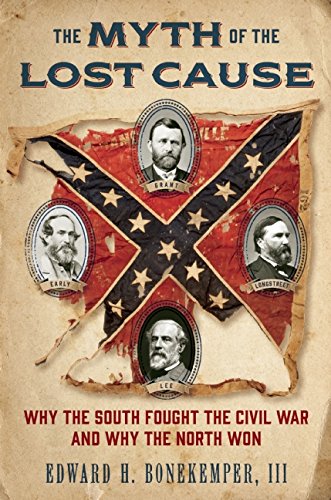
The Myth of the Lost Cause: Why the South Fought the Civil War and Why the North Won, by Edward H. Bonekemper III

Download PDF Ebook The Myth of the Lost Cause: Why the South Fought the Civil War and Why the North Won, by Edward H. Bonekemper III
The former Confederate states have continually mythologized the South’s defeat to the North, depicting the Civil War as unnecessary, or as a fight over states’ Constitutional rights, or as a David v. Goliath struggle in which the North waged “total war” over an underdog South. In The Myth of the Lost Cause, historian Edward Bonekemper deconstructs this multi-faceted myth, revealing the truth about the war that nearly tore the nation apart 150 years ago.
The Myth of the Lost Cause: Why the South Fought the Civil War and Why the North Won, by Edward H. Bonekemper III- Amazon Sales Rank: #242559 in Books
- Published on: 2015-10-05
- Original language: English
- Number of items: 1
- Dimensions: 9.10" h x 1.40" w x 6.20" l, .0 pounds
- Binding: Hardcover
- 352 pages
About the Author Edward H. Bonekemper III is Book Review Editor of Civil War News and a former adjunct lecturer in military history at Muhlenberg College. He earned a B.A. cum laude in American history from Muhlenberg College, an M.A. in American history from Old Dominion University, and a J.D. from Yale Law School.His prior Civil War books include Lincoln and Grant, Grant and Lee, McClellan and Failure, Incompetence and Worse, A Victor, Not a Butcher, and How Robert E. Lee Lost the Civil War.Bonekemper is a frequent speaker at Civil War Roundtables (Chicago, Milwaukee, New York, Washington, LA, San Francisco, San Diego, Seattle, Scottsdale, Philadelphia, Baltimore, Wilmington, etc.) and other groups. He has been a guest speaker at the Smithsonian Institution ten times, the Chautauqua Institute, the Delta Queen, the Lincoln Group of Washington, and other prestigious organizations.He served as a Federal Government attorney-manager for over 34 years, including 11 years on active duty with the U.S. Coast Guard. He is a retired Commander, U.S. Coast Guard Reserve.

Where to Download The Myth of the Lost Cause: Why the South Fought the Civil War and Why the North Won, by Edward H. Bonekemper III
Most helpful customer reviews
41 of 49 people found the following review helpful. An Exceptional Book, Well Written and Meticulously Researched By sbfarbman A July 5th Washington Post article this year quoted Patricia Hardy, a member of the State Board of Education in Texas, as stating that slavery was a “side issue to the Civil War. There would be those who would say the reason for the Civil War was over slavery. No. It was over states’ rights.”Ms. Hardy should read Ed Bonekemper’s latest book, "The Myth of the Lost Cause." In this, his sixth Civil War book, which is perhaps his finest, Mr. Bonekemper uses his gifts as both an historian and a lawyer to shred revisionist history that has tried to sanitize the reasons Southern states seceded from the Union. Mr. Bonekemper’s research is thorough; his arguments are compelling. The high percentage of slaves compared with the total population in the seceding states (57 percent in South Carolina) and the high percentage of slave-holding families in those states (49 percent in Mississippi) are strong indicators of the importance of slavery in the decisions of these states to leave the Union. The reader is provided with the actual language from the declarations at the state secession conventions. Mississippi got right to the point: “Our position is thoroughly identified with the institution of slavery.” At that time, the issue of states’ rights was not on the agenda of the seceding states; Southerners were dissatisfied instead with the Northern exercise of their states’ rights – failing to return fugitive slaves in accordance with the Constitution and Federal law! Additionally, the South’s rejection of the use of slaves as soldiers and the South’s failure to promise to end slavery to gain the diplomatic support of Britain and France demonstrated that the independence of the Confederacy was a lessor priority than the preservation of slavery. It is clear that the only states’ right the Southern states were interested in was the right to maintain slavery.I agree with one reviewer’s assessment that the first 95 pages alone are worth the price of the book. After refuting the states’ rights myth, the author refutes other popularly held beliefs: (1) the Confederacy had no chance to win the war; (2) Robert E. Lee was one of history’s greatest generals; (3) General Longstreet, not Lee, was responsible for the Confederacy’s loss at Gettysburg; (4) Ulysses S. Grant was a “butcher” who won the war with superior numbers and brutality; and (5) the North won because it waged total war against the South. Mr. Bonekemper explains that the allegation that the North won by waging total war is a myth, because it fails to distinguish between “hard war,” which involves the destruction of enemy armies and property, and “total war,” which adds the deliberate and systematic killing and rape of civilians. As the author demonstrates, unlimited, large-scale attacks on civilians are absent from the Civil War.There are two reviewers who inexplicably gave this extraordinary book only one star. One reviewer said that the book was intentionally deceptive, but he failed to say in what way. He further claimed that the author omitted important facts, but he failed to clarify what these were. It is questionable whether this reviewer even read the book, and I find his unsupported conclusions to be a disservice to potential readers. Although the second one-star reviewer did provide specific objections, they were either irrelevant to the author’s points or they were factually incorrect. The reviewer states that only 10 percent of whites were wealthy enough to own slaves, even though a chart is provided showing that the percentage of slave-owning families in the 11 states that seceded ranged from 25 to 49, with the average being 31. Moreover, Mr. Bonekemper points out that fear of Negro equality by Southern whites who were not slave owners helped to reinforce the institution of slavery. This is an exceptional book, well written and meticulously researched, and should be read by all who want to truly understand the history of the Civil War. I challenge the State Board of Education in Texas it to make "The Myth of the Lost Cause" part of its curriculum.
26 of 34 people found the following review helpful. A Lost Cause In Legend Only By James M These are dark days indeed for adherents of the old Confederacy’s legacy: Their flag is denigrated and banned from display, their monuments defiled, even the relics of their heroes are disinterred and removed from public grounds. This timely new book from noted historian and lecturer Ed Bonekemper will only add to their plight. 'The Myth Of The Lost Cause' strikes directly at the deeply flawed arguments advancing noble motives for the Civil War south and the Confederacy.A casual student of American history has always been perplexed by the seeming imperishability of patently fallacious arguments defending the south and its defeat. Encountering these landmines time after time in otherwise academically rigorous works, one is left with the impression that there has been, for over a century, an alternate history conspiracy along the lines of Turtledove’s 'Guns Of The South'.Well, it turns out that there really is an alternate history, albeit without AK-47 rifles. In a carefully researched, persuasively written and thoroughly documented narrative, Mr. Bonekemper outlines creation of the lost cause myth, from the writings of actual participants in the war, through early and mid 20th Century authors such as biographer Douglas Southall Freeman, to works as recent as the massive three volume history by Shelby Foote.Mr. Bonekemper takes on directly the several fallacies of the Lost Cause arguments. The first third of the book is devoted to an unassailable refutation of the most heinous of these, the argument for some cause other than slavery for the Civil War. These ninety or so pages are alone worth the price of the book. The first six pages of Bonekemper’s concluding chapter wrap up the slavery subject as neatly as has ever been done. Not since James McPherson’s article on the same topic in the now-defunct North and South Magazine has there been a summary of this issue as succinct and concise.Countering the myth's supporting dogmas, Mr. Bonekemper develops themes first advanced in his several previous books. He asserts convincingly once again that Robert E. Lee really did lose the Civil War for the Confederacy by wasting precious manpower on an offensive strategy and aggressive tactics, and by appropriating Confederate resources for his own operations at the expense of other theaters. And Grant was no butcher, says Bonekemper, because, among other reasons, he had fifty thousand fewer casualties than Lee despite having twice Lee’s total numbers. Longstreet likewise was no traitor, because it was he, after all, who wanted to make the flanking maneuver at Gettysburg where Lee insisted on a fatal direct assault. Finally, after dismissing several other arguments, Mr. Bonekemper hypothesizes that a Confederate defensive strategy might have resulted in at least a stalemate, thus achieving secession states’ objectives – territorial integrity, independence and foreign recognition. In this realm of “what ifs” it's a valid proposition, but good faith opinion might differ.Having a handsome dust jacket, beautifully bound and printed, extensively footnoted and with full bibliography, this book belongs on every Civil War student’s bookshelf.
7 of 8 people found the following review helpful. Interesting but Uneven By Amazon Customer A well written and well-researched book that effectively debunks many of the 'Lost Cause' legends that surround the Civil War. Bonekemper is especially effective at revealing the true cause of Succession - undeniably, slavery - using extensive quotes taken from emissaries, ambassadors, and even Succession document themselves. Allowing the actors to speak for themselves through these quotes is devastating to the legend of State's Rights as the primary motivator of the conflict. The book loses focus as it transitions to some of the secondary arguments. The author presents solid evidence of Grant as a skilled and determined leader, but his efforts to discredit Lee come off as forced. He relies heavily on casualty tables and differentials to bolster his arguments, but the numbers are often dubious and their interpretation disingenuous. Curiously, his own narrative sometimes fails to synch with these data tables. The criticism of Lee's tactics draws heavily from McWhitney & Jamison's Attack and Die, a statistical analysis of casualty rates that argued that the South's best and only chance was to fight a purely defensive war. Bonekemper falls into the same trap of breaking down battles and casualties in the manner that one would the play-calling in a football game, ignoring entirely the immense pressure and stress that affect military decision-making. Lee's successes in the first half of the war are due more to his moral domination of his opponents than to his handling of troops, a fact that cannot be reflected on a table or graph. It wasn't statistics that froze Hooker when he emerged from the Wilderness - it was the fear of Lee's aggressiveness. Grant had this same mastery over the Confederate generals in the West, as the Vicksburg campaign clearly illustrated. Bonekemper even engages in second-guessing basic tactical moves, such as the decision to attack 'en echelon' on the second day at Gettysburg. Bonekemper correctly points out some of the other flaws in Lee's leadership - most notably his inadequate staff and his troubling habit of launching frontal attacks on prepared positions. Gettysburg was certainly Lee's worst battle, and the book rightly holds him accountable for his failure there, but the portrayal of Lee as ineffective rings false. Overall, it's a good thesis and a good read.
See all 34 customer reviews... The Myth of the Lost Cause: Why the South Fought the Civil War and Why the North Won, by Edward H. Bonekemper IIIThe Myth of the Lost Cause: Why the South Fought the Civil War and Why the North Won, by Edward H. Bonekemper III PDF
The Myth of the Lost Cause: Why the South Fought the Civil War and Why the North Won, by Edward H. Bonekemper III iBooks
The Myth of the Lost Cause: Why the South Fought the Civil War and Why the North Won, by Edward H. Bonekemper III ePub
The Myth of the Lost Cause: Why the South Fought the Civil War and Why the North Won, by Edward H. Bonekemper III rtf
The Myth of the Lost Cause: Why the South Fought the Civil War and Why the North Won, by Edward H. Bonekemper III AZW
The Myth of the Lost Cause: Why the South Fought the Civil War and Why the North Won, by Edward H. Bonekemper III Kindle

Tidak ada komentar:
Posting Komentar