Tikal: Paleoecology of an Ancient Maya CityFrom Cambridge University Press
It is quite simple to check out guide Tikal: Paleoecology Of An Ancient Maya CityFrom Cambridge University Press in soft data in your gizmo or computer. Once again, why ought to be so hard to obtain guide Tikal: Paleoecology Of An Ancient Maya CityFrom Cambridge University Press if you can decide on the simpler one? This website will relieve you to choose and also pick the very best collective publications from one of the most wanted seller to the launched book lately. It will consistently upgrade the compilations time to time. So, connect to internet and visit this site consistently to obtain the brand-new book each day. Now, this Tikal: Paleoecology Of An Ancient Maya CityFrom Cambridge University Press is yours.
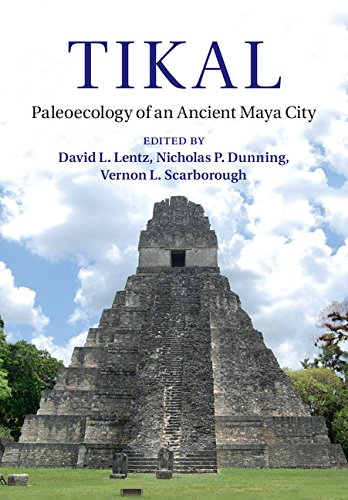
Tikal: Paleoecology of an Ancient Maya CityFrom Cambridge University Press

Best Ebook Online Tikal: Paleoecology of an Ancient Maya CityFrom Cambridge University Press
The primary theoretical question addressed in this book focuses on the lingering concern of how the ancient Maya in the northern Petén Basin were able to sustain large populations in the midst of a tropical forest environment during the Late Classic period. This book asks how agricultural intensification was achieved and how essential resources, such as water and forest products, were managed in both upland areas and seasonal wetlands, or bajos. All of these activities were essential components of an initially sustainable land use strategy that eventually failed to meet the demands of an escalating population. This spiraling disconnect with sound ecological principles undoubtedly contributed to the Maya collapse. The book's findings provide insights that broaden the understanding of the rise of social complexity - the expansion of the political economy, specifically - and, in general terms, the trajectory of cultural evolution of the ancient Maya civilization.
Tikal: Paleoecology of an Ancient Maya CityFrom Cambridge University Press- Amazon Sales Rank: #2297860 in eBooks
- Published on: 2015-03-31
- Released on: 2015-02-03
- Format: Kindle eBook
Review "This interdisciplinary study blends agroforestry and hydroarchaeology to show culture and nature interacting in the florescence and fall of a great Maya city. Rarely has the engineered environment of an ancient community been analyzed in such scrupulous detail: Tikal's temples and their socioeconomic foundations are, we now perceive, equally impressive." Norman Hammond, University of Cambridge
About the Author David L. Lentz is Professor of Biological Sciences and Executive Director of the Center for Field Studies at the University of Cincinnati. He is the author of more than ninety publications that have appeared as journal articles, book chapters, and three books, including this volume. He is the editor of Imperfect Balance: Landscape Transformations in the Precolumbian Americas (2000) and the coauthor of Seeds of Central America and Southern Mexico (2005, with Ruth Dickau). A Fellow of the Linnean Society of London and a former Fulbright Scholar, he has received support for his ancient landscape studies and paleoethnobotanical research from the National Science Foundation, the Wenner-Gren Foundation, the National Endowment for the Humanities, the National Geographic Society, the Heinz Family Foundation, and the Foundation for the Advancement of Mesoamerican Studies.Nicholas P. Dunning is Professor of Geography at the University of Cincinnati. He is a geoarchaeologist and cultural ecologist specializing in the neotropics. He has published several books and more than ninety articles and book chapters, including those in this volume.Vernon L. Scarborough is Distinguished University Research Professor and Charles Phelps Taft Professor in the Department of Anthropology at the University of Cincinnati. His work emphasizes sustainability and global water systems through an examination of past engineered landscapes, using comparative ecological and transdisciplinary perspectives. In addition to editing Water and Humanity: A Historical Overview for UNESCO, he is a steering committee member of the Integrated History and Future of People on Earth (IHOPE) network, whose main office is located at Uppsala University, and an active organizer of the subgroup IHOPE-Maya. He is a senior editor for the journal WIREs Water and a series editor for Cambridge University Press's New Directions in Sustainability and Society series. He has published ten books - eight of them edited, including this volume - and authored more than ninety book chapters or journal articles.

Where to Download Tikal: Paleoecology of an Ancient Maya CityFrom Cambridge University Press
Most helpful customer reviews
2 of 2 people found the following review helpful. Brilliant technical research on a Maya city By E. N. Anderson First a warning: this is a highly technical book, not for the general reader. That said, it is extremely important. It records the success of Tikal for a thousand years, during the last 200 of which it was one of the great cities of the world, with some 45,000 people and control over a large territory. It fell due to drought. It succeeded due to Maya genius at landscape management. They managed the very limited water resource by reservoirs. They farmed maize, beans, squash, root crops and tree crops, using field rotation that could have been as short as 3 years fallow between farming the maize fields. Fertility was restored by cropping systems, but also from an unexpected source: volcanic ash. Perhaps the most intriguing new finding at Tikal is that a frequent heavy rain of volcanic ash (from volcanoes to the south) kept restoring phosphorus and other minerals. The Maya prevented soil erosion; the reservoirs show very little infill over that enormous time. Most interesting of all, they preserved a great deal of mature forest, as shown by the continued availability of big logs for construction. Firewood required a huge amount of wood, yet the Maya protected enough to keep them in wood over the centuries--in marked contrast to modern people of the area, who have eliminated most of the forest in the last 50 years. The Tikal forest included many trees still a major part of Maya mature forests (Nectandra, etc.) and older secondary forest (see list on p. 148--a fine set of old-regrowth species).The city is set about with bajos--low-lying areas with water-laid or water-altered soils. Some bajos are highly fertile, but few of those near Tikal; most in that area have poor, acidic, clay soils that made them relatively useless. Such bajos tend to become impenetrable thickets of tinte (logwood), a thorny tree difficult to get rid of. Alluvial wash into bajos, however, can be extremely fertile, and such areas were heavily cropped in Tikal's golden days.The authors draw limited but pointed contrasts with modern tropical land management, which is disastrous. Modern lowland Guatemala will be an ecological ruin in a few years. The authors point out (p. 281) that “…the fact that it was ecologically resilient for more than a millennium is one of the strongest testaments to Tikal’s legacy for human history.”
See all 1 customer reviews... Tikal: Paleoecology of an Ancient Maya CityFrom Cambridge University PressTikal: Paleoecology of an Ancient Maya CityFrom Cambridge University Press PDF
Tikal: Paleoecology of an Ancient Maya CityFrom Cambridge University Press iBooks
Tikal: Paleoecology of an Ancient Maya CityFrom Cambridge University Press ePub
Tikal: Paleoecology of an Ancient Maya CityFrom Cambridge University Press rtf
Tikal: Paleoecology of an Ancient Maya CityFrom Cambridge University Press AZW
Tikal: Paleoecology of an Ancient Maya CityFrom Cambridge University Press Kindle

Tidak ada komentar:
Posting Komentar