Tools for Critical Thinking in Biology, by Stephen H. Jenkins
So, even you need obligation from the company, you may not be puzzled anymore due to the fact that publications Tools For Critical Thinking In Biology, By Stephen H. Jenkins will certainly always assist you. If this Tools For Critical Thinking In Biology, By Stephen H. Jenkins is your ideal partner today to cover your job or work, you can as soon as possible get this book. Exactly how? As we have informed previously, merely go to the link that we offer here. The conclusion is not only guide Tools For Critical Thinking In Biology, By Stephen H. Jenkins that you search for; it is how you will certainly get many books to sustain your skill and also ability to have piece de resistance.
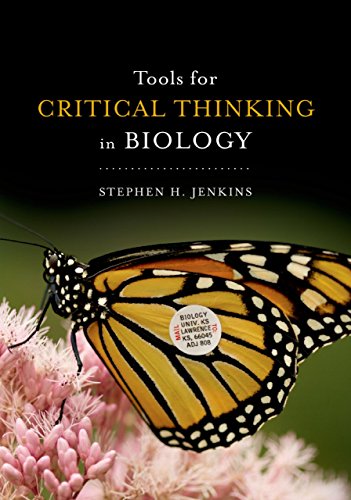
Tools for Critical Thinking in Biology, by Stephen H. Jenkins

Read Online Ebook Tools for Critical Thinking in Biology, by Stephen H. Jenkins
The American Association for the Advancement of Science's report on Vision and Change in Undergraduate Biology Education suggests that instructors "can no longer rely solely on trying to cover a syllabus packed with topics" but rather should "introduce fewer concepts but present them in greater depth." They further suggest that the principles embodied in a set of core concepts and competencies should be the basis for all undergraduate biology courses, including those designed for nonmajors.The theme of Tools for Critical Thinking in Biology will be the first and most fundamental of these competencies: the ability to apply the process of science. Biology courses and curricula must engage students in how scientific inquiry is conducted, including evaluating and interpreting scientific explanations of the natural world. The book uses diverse examples to illustrate how experiments work, how hypotheses can be tested by systematic and comparative observations when experiments aren't possible, how models are useful in science, and how sound decisions can be based on the weight of evidence even when uncertainty remains. These are fundamental issues in the process of science that are important for everyone to understand, whether they pursue careers in science or not. Where other introductory biology textbooks are organized by scientific concepts, Tools for Critical Thinking in Biology will instead show how methods can be used to test hypotheses in fields as different as ecology and medicine, using contemporary case studies. The book will provide students with a deeper understanding of the strengths and weaknesses of such methods for answering new questions, and will thereby change the way they think about the fundamentals of biology.
Tools for Critical Thinking in Biology, by Stephen H. Jenkins- Amazon Sales Rank: #1526515 in eBooks
- Published on: 2015-04-28
- Released on: 2015-04-28
- Format: Kindle eBook
Review "Steve Jenkins has done it again! An expert biologist and wonderful teacher who cares deeply about his students-and now about us, his audience-Steve has the knack of a science journalist to turn scientific investigation into a series of fascinating stories. In the process of reading about research into the amazing behaviors of a variety of critters, the genetic basis of diseases, and much else, we almost painlessly learn to think critically about claims, evidence, and argument. What emerges is the realization that we don't have to be experts in order to ask intelligent, probing questions." --Thomas Nickles, University of Nevada Reno
"Useful in epidemiology as well as biology. Recommended." --CHOICE"Tools for Critical Thinking in Biology effectively tackles many important issues essential to scientific thinking and biological inquiry." --The Quarterly Review of BiologyAbout the Author Stephen H. Jenkins is Emeritus Professor of Biology at the University of Nevada. He is the author of How Science Works: Evaluating Evidence in Biology and Medicine (Oxford University Press, 2004). He also blogs regularly about critical thinking at https://critical-thinking.blogs.unr.edu/.

Where to Download Tools for Critical Thinking in Biology, by Stephen H. Jenkins
Most helpful customer reviews
2 of 2 people found the following review helpful. Entertaining and informative By Advisor The author's purpose is to assist the reader in understanding the thought behind the formation and testing of scientific hypotheses. Professor Jenkins writes well, and is a pleasure to read. Quite apart from his goal of educating the reader, Professor Jenkins chooses very engaging examples that immediately got me interested, so much so that I often skipped to the end of the discussion to see how it all turned out, the way some readers of mystery stories have to peek at the ending to calm their impatience.So the book is engaging by virtue of the writing and manner of the author, and by virtue of the examples. How about the pedagogy: will the reader become a more critical thinker? That depends upon the reader's approach: if they have an interest in evaluating evidence, in using models, or even in the deeper philosophical underpinnings of the entire program, the reader will benefit in proportion to the attention they give to the details. To assist the reader, each chapter ends with a section "Resources for further exploration" or "Questions to ponder" that can engage one's personal development.The book also contains supplementary appendices elaborating upon topics that would prove too detailed for the main exposition.Aside from the delightful examples used throughout the book, the author continually inspired me with his broad, impartial, and acute framework for each one, a demonstration by example of critical thinking far above mere nitpicking.From the philosophical standpoint, which is only a small part of this book and not Professir Jenkins' focus, the author presents James Lett's six criteria for a useful theory ("Science, Reason, and Anthropology"; see first url below): falsifiability, logic, comprehensiveness, honesty, replicability, and sufficiency. These desiderata owe much to Karl Popper ("Logic of Scientific Discovery"; see second url below) and Thomas Kuhn ("Structure of Scientific Revolutions"; see third url below) who have presented the matter in a more abstract manner. Readers with this bent of mind might also look at Jim Baggott's "Farewell to Reality" (see fourth url below) which is a polemical work very different in tone to Professor Jenkins'. These philosophers dwell upon the subjective nature of evaluating how well a theory fits these criteria, which poses the dilemma for science that it is not itself 100% objective.Altogether, this book is a gem.Lett url: http://www.amazon.com/Science-Reason-Anthropology-Principles-Rational/dp/0847685934/ref=sr_1_1?s=books&ie=UTF8&qid=1461867474&sr=1-1&keywords=James+LettPopper url: http://www.amazon.com/Logic-Scientific-Discovery-Routledge-Classics/dp/0415278449/ref=sr_1_1?s=books&ie=UTF8&qid=1461866935&sr=1-1&keywords=karl+popper+the+logic+of+scientific+discoveryKuhn url: http://www.amazon.com/Structure-Scientific-Revolutions-50th-Anniversary/dp/0226458121/ref=sr_1_1?s=books&ie=UTF8&qid=1461866737&sr=1-1Baggott url: http://www.amazon.com/Farewell-Reality-Physics-Betrayed-Scientific/dp/1605984728/ref=cm_rdp_product
1 of 1 people found the following review helpful. A Better Guide to Life By Douglas Smith This is a wonderful book that will make your life better - and it is not a self-help book. Rather this book is useful through giving you thoughtful tips on how to think better or more critically. Some would argue that this may be the most important life skill. I am a former student of the author, Stephen Jenkins, and he was one of the finest teachers I encountered throughout my entire education. He uses this fine teachering in this book: selection of timely and pressing issues facing life, clear writing, sound examples of how to use data and evidence to arrive at good decisions. Many of the examples I was familar with, but the writing and thinking were so good that I still learned more reading the book and pondering the examples. Nothing about Jenkins shows hubris, his only goal is to help you and take a small step toward a better society, a society where individuals make good decisions based on evidence, not based on what they want or how they want the world to work, but how it is and how to deal with it - intelligently!. As simple as that sounds it is really radical, and Jenkins guides us throuogh the process. This is a really good book that I looked forward to reading at night, and I have suggested it to several people to help them in life.
1 of 1 people found the following review helpful. It's all about the data ... By Amazon Customer An excellent book for introducing the non-scientist to the ways in which scientists use and evaluate data, as well as each other's research. Book also uses interesting examples and is written in a user-friendly and entertaining way. This book would make for a good "object of discussion" for college courses in disciplines ranging from science education to mass comm to policy, and including philosophy of science.
See all 3 customer reviews... Tools for Critical Thinking in Biology, by Stephen H. JenkinsTools for Critical Thinking in Biology, by Stephen H. Jenkins PDF
Tools for Critical Thinking in Biology, by Stephen H. Jenkins iBooks
Tools for Critical Thinking in Biology, by Stephen H. Jenkins ePub
Tools for Critical Thinking in Biology, by Stephen H. Jenkins rtf
Tools for Critical Thinking in Biology, by Stephen H. Jenkins AZW
Tools for Critical Thinking in Biology, by Stephen H. Jenkins Kindle

Tidak ada komentar:
Posting Komentar