The Most Dangerous Enemy: A History of the Battle of Britain, by Stephen Bungay
New updated! The The Most Dangerous Enemy: A History Of The Battle Of Britain, By Stephen Bungay from the very best writer and author is now offered here. This is guide The Most Dangerous Enemy: A History Of The Battle Of Britain, By Stephen Bungay that will certainly make your day reviewing comes to be completed. When you are seeking the published book The Most Dangerous Enemy: A History Of The Battle Of Britain, By Stephen Bungay of this title in the book shop, you could not discover it. The issues can be the minimal versions The Most Dangerous Enemy: A History Of The Battle Of Britain, By Stephen Bungay that are given in guide shop.
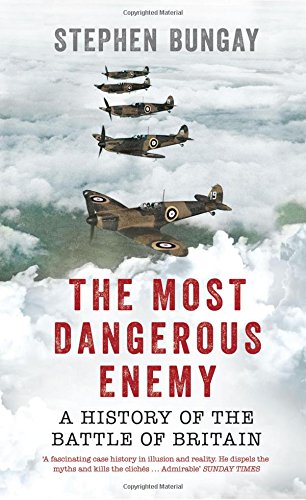
The Most Dangerous Enemy: A History of the Battle of Britain, by Stephen Bungay

Best Ebook PDF The Most Dangerous Enemy: A History of the Battle of Britain, by Stephen Bungay
"The magnitude and vital importance of the Battle of Britain has found a superb chronicler in Stephen Bungay, whose book is the best single-volume history to be published in over a decade." - Andrew Roberts
Stephen Bungay's magisterial history is acclaimed as the account of the Battle of Britain.
Unrivalled for its synthesis of all previous historical accounts, for the quality of its strategic analysis and its truly compulsive narrative, this is a book ultimately distinguished by its conclusions - that it was the British in the Battle who displayed all the virtues of efficiency, organisation and even ruthlessness we habitually attribute to the Germans, and they who fell short in their amateurism, ill-preparedness, poor engineering and even in their old-fashioned notions of gallantry.
An engrossing read for the military scholar and the general reader alike, this is a classic of military history that looks beyond the mythology, to explore all the tragedy and comedy; the brutality and compassion of war.
The Most Dangerous Enemy: A History of the Battle of Britain, by Stephen Bungay- Amazon Sales Rank: #302144 in Books
- Published on: 2015-10-01
- Original language: English
- Number of items: 1
- Dimensions: 9.25" h x 1.50" w x 6.25" l, .84 pounds
- Binding: Paperback
- 240 pages
Review 'Stephen Bungay delves into new ground. These threads have been woven together to form an eloquent and informative tapestry... It will be difficult for a new work on this subject to add any more to our knowledge of those months in 1940' -- Wingspan 'The magnitude and vital importance of the Battle of Britain has found a superb chronicler in Stephen Bungay, whose book is the best single-volume history to be published in over a decade' -- Andrew Roberts 'The most exhaustive and detailed account of the Battle of Britain that has yet appeared' -- Times Literary Supplement 'A fascinating case history in illusion and reality. He dispels the myths and kills the cliches... Admirable' -- Sunday Times
From the Publisher Already hailed as the standard work, The Most Dangerous Enemy is a supremely authoritative history of the British battle that galvanized the public imagination and symbolized the destiny of a nation. But in this rigorous re–investigation of the Battle of Britain, Stephen Bungay tells a story full of revelations. Whether assessing the development of radar or the relative merits of the Spitfire, Hurricane, and Messerschmitt, he uncovers the unexpected truth behind many time–honored myths. Not only a major work of modern history but also a truly compelling narrative, The Most Dangerous Enemy confirms the Battle of Britain as a crucial event in European history.
About the Author
STEPHEN BUNGAY was born in Kent in 1954 and educated at Oxford and Tübingen. He has spent his career working for the Boston Consulting Group in London and Munich as a chief executive in an insurance company. He is now working in executive education, specialising in military history and modern management practice. His first book, The Most Dangerous Enemy: A History of the Battle of Britain, published by Aurum in 2001 has now become accepted as the definitive book on the subject.
His subsequent book, Alamein, also published by Aurum, was praised by Lawrence James in the Daily Mail as 'a brilliant balance between lucid analysis and piquant detail', and by John Lukacs in the Los Angeles Times as 'terse and brilliantly written by a thorough master of his subject'.
He regularly appears on TV documentaries about the Second World War. He lives in Kent.

Where to Download The Most Dangerous Enemy: A History of the Battle of Britain, by Stephen Bungay
Most helpful customer reviews
91 of 94 people found the following review helpful. A REFLECTION OF THE BATTLE ON "BATTLE OF BRITAIN DAY" 2004 By KOMET Though many books have been written on the Battle of Britain since the end of the Second World War, Stephen Bungay's book offers some fresh insights on the Battle.Using material from both British and German sources, Bungay shows that the Luftwaffe, despite its impressive show of strength from Poland to the defeat of France in June 1940, was not capable of waging a strategic bombing campaign against Britain which could have defeated it. An invasion of Britain could only have succeeded through a concerted effort of the German Army, Navy, and Luftwaffe.Furthermore, the German leadership was not wholly confident that Germany could defeat Britain. For a short time after France had fallen, it had hoped that Britain would be conciliatory to Germany and sue for peace. But when it became clear that Britain would fight, the Luftwaffe adapted a series of shifting tactics to neutralize and destroy RAF Fighter Command.First, there were the attacks on shipping in the English Channel and radar stations. Then the Luftwaffe shifted over to attacks on RAF airbases, which, had they been more consistently carried out, might well have "neutered" RAF Fighter Command. Instead, Hitler, in a pique of anger over Britain having dropped bombs on Berlin, set the Luftwaffe to bombing London. This gave RAF Fighter Command the breathing space it needed to rest, refit, and take on the Luftwaffe in larger numbers. (Bungay shows that throughout the Battle, British aircraft production increased significantly relative to German aircraft production.)Germany, full of hubris in the summer of 1940, made the mistake of underestimating the capacity of the RAF to challenge the Luftwaffe and Britain's will to fight for its survival.The book is well-written, comprehensive, easy to read, and comes HIGHLY RECOMMENDED.
67 of 71 people found the following review helpful. Achtung, Indianer! By Bruce Loveitt No, it isn't the shout of a German tourist on his way to the Indianapolis 500, enthusiastic about reaching the Indiana border. It's the shout of a German bomber or fighter pilot, spotting an approaching Spitfire or Hurricane. However, mentioning the Indianapolis 500 isn't as unrelated as it seems. Mr. Bungay compares putting a recently trained pilot into the Battle of Britain to taking someone who has just obtained their drivers license and entering them in a Grand Prix motor race. Only, imagine the other drivers have machine guns! After you read this book you will have an even healthier respect for what the pilots of the RAF and the Luftwaffe had to go through. Imagine flying at 250-300 miles per hour and trying to pick out an opponent amongst a bunch of specks around and above and below you, trying to get behind one of them and hoping to get off a 2-3 second machine gun burst while attempting to get in some quick glances to make sure no one is sneaking up on you! You had a very good chance of not surviving your first few missions. If you got past the first few missions you then had enough experience to have a pretty good chance of surviving, but it was unlikely that you would become an ace. An ace was defined as a pilot that had made 5 kills. Mr. Bungay estimates that only about 5% of the pilots on either side became aces, because it was a rare person who could be both a great pilot and an accurate marksman under the circumstances. The author asserts that the Luftwaffe never really came close to winning the Battle of Britain. German Intelligence overestimated the number of RAF planes they were shooting down and underestimated the ability of British industry to replace the aircraft that were destroyed. The Germans hoped to win a war of attrition. They thought they could shoot down 5 times as many planes as they themselves lost. The RAF actually shot down more planes, and after the first few months had both more planes and more pilots than when they had started. The main strategic failing of the Luftwaffe was that they made no serious attempt to knock out the British radar network. That meant the RAF was almost always ready for whatever the Luftwaffe would throw at them, so planes were rarely caught on the ground, as they had been in Poland. Mr. Bungay does not neglect the human element of the story. For example, he tells the tale of Patrick and Tony Woods-Scawen, two brothers who were pilots and who fell in love with the same girl, Una Lawrence. Patrick was engaged to Una but Tony "stole her away" and married her. Tony had very poor eyesight but passed the vision test for pilots by memorizing the eye chart. Both brothers were killed during the Battle of Britain. One of the more touching pages of the book contains a photo of the two brothers at the top, happy and smiling, while underneath is another photo of Una and her father-in-law, looking very sad, standing outside Buckingham Palace while photographers took a picture of the Distinguished Flying Crosses that the brothers had been awarded.....
29 of 29 people found the following review helpful. The Most Dangerous Enemy By MR A L M O'HARE This is a remarkable book. It is rare to read something that totally changes ones perceptions in the way that this book does. Bungay convincingly dispels the two enduring myths about the Battle of Britain - firstly, the image of the ruthlessly efficient Nazi War machine pitted against the valiant but amateurish "old school tie" RAF, and secondly the perceived wisdom that the Battle was a "close run thing".However, even whilst dispelling the myths, Bungay succeeds in doing so without detracting in any way from the courage and heroism shown by the young men and women on both sides. On the contrary, by stripping away the fantasy and leaving us with the grim realities of the Battle, the quiet heroism of the combatants is all the more remarkable.This is a thoroughly professional piece of historical analysis, but it is also an engaging and very readable book.
See all 60 customer reviews... The Most Dangerous Enemy: A History of the Battle of Britain, by Stephen BungayThe Most Dangerous Enemy: A History of the Battle of Britain, by Stephen Bungay PDF
The Most Dangerous Enemy: A History of the Battle of Britain, by Stephen Bungay iBooks
The Most Dangerous Enemy: A History of the Battle of Britain, by Stephen Bungay ePub
The Most Dangerous Enemy: A History of the Battle of Britain, by Stephen Bungay rtf
The Most Dangerous Enemy: A History of the Battle of Britain, by Stephen Bungay AZW
The Most Dangerous Enemy: A History of the Battle of Britain, by Stephen Bungay Kindle

Tidak ada komentar:
Posting Komentar