The Second Day at Gettysburg: The Attack and Defense of the Union Center on Cemetery Ridge, July 2, 1863, by David Shultz, Scott Mingus
What sort of publication The Second Day At Gettysburg: The Attack And Defense Of The Union Center On Cemetery Ridge, July 2, 1863, By David Shultz, Scott Mingus you will choose to? Currently, you will certainly not take the published book. It is your time to obtain soft documents publication The Second Day At Gettysburg: The Attack And Defense Of The Union Center On Cemetery Ridge, July 2, 1863, By David Shultz, Scott Mingus rather the published documents. You could enjoy this soft documents The Second Day At Gettysburg: The Attack And Defense Of The Union Center On Cemetery Ridge, July 2, 1863, By David Shultz, Scott Mingus in at any time you anticipate. Also it remains in anticipated location as the other do, you can review the book The Second Day At Gettysburg: The Attack And Defense Of The Union Center On Cemetery Ridge, July 2, 1863, By David Shultz, Scott Mingus in your device. Or if you desire a lot more, you could continue reading your computer or laptop computer to obtain full screen leading. Juts find it right here by downloading and install the soft documents The Second Day At Gettysburg: The Attack And Defense Of The Union Center On Cemetery Ridge, July 2, 1863, By David Shultz, Scott Mingus in web link web page.
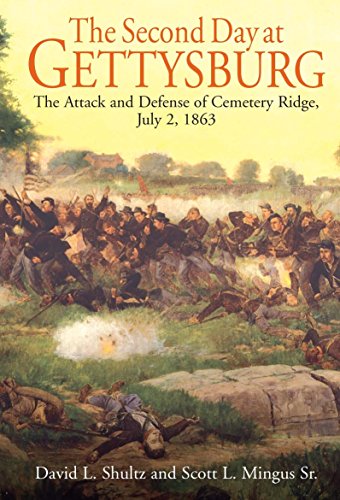
The Second Day at Gettysburg: The Attack and Defense of the Union Center on Cemetery Ridge, July 2, 1863, by David Shultz, Scott Mingus

Best Ebook PDF Online The Second Day at Gettysburg: The Attack and Defense of the Union Center on Cemetery Ridge, July 2, 1863, by David Shultz, Scott Mingus
On the afternoon of July 2, 1863, Lt. Gen. James Longstreet struck the Union left flank with a massive blow that collapsed Dan Sickles’ advanced position in the Peach Orchard and rolled northward, tearing open a large gap in the center of the Federal line on Cemetery Ridge. Fresh Confederates from A. P. Hill’s Corps advanced toward the mile-wide breach, where Southern success would split the Army of the Potomac in two. The fate of the Battle of Gettysburg hung in the balance.Despite the importance of the position, surprisingly few Union troops were available to defend Cemetery Ridge. Major General Winfield S. Hancock’s veteran Second Corps had been whittled from three divisions to less than one after Gibbon’s division was sucked into earlier fighting and Caldwell’s command was shattered in the Wheatfield. With little time and few men, Hancock determined to plug the yawning gap. Reprising Horatio at the Bridge, the gallant commander cobbled together various commands and refused to yield the precious acres in Plum Run ravine. The swirling seesaw fighting lasted for hours and included hand-to-hand combat and personal heroics of which legends are made.The Second Day at Gettysburg: The Attack and Defense of the Union Center on Cemetery Ridge, July 2, 1863 expands on David Shultz and David Wieck’s critically acclaimed earlier work The Battle Between the Farm Lanes. This completely revised and expanded study, which includes new photographs, original maps, and a self-guided tour of the fighting, is grounded in extensive research and unmatched personal knowledge of the terrain. The result is a balanced and compelling account of this often overlooked portion of the battle.About the Authors: David L. Shultz is the author of numerous books, pamphlets, and articles concerning the Battle of Gettysburg including the acclaimed Double Canister at Ten Yards: The Federal Artillery and the Repulse of Pickett’s Charge; Guide to Pennsylvania Troops at Gettysburg; and The Battle Between the Farm Lanes: Hancock Saves the Union Center. His acclaimed historical pamphlet in 1997 entitled “The Baltimore Pike Artillery Line and Kinzie’s Knoll,” received special recognition from numerous battlefield preservation societies. He is the recipient of numerous awards including special citations from the House of Representatives and Commonwealth of Pennsylvania for Meritorious Public Service for Battlefield Preservation. He is currently working on an extensive and comprehensive tactical study on the artillery at Gettysburg.In addition to co-authoring The Battle Between the Farm Lanes and The Second Day at Gettysburg, David F. Wieck has written several articles on Civil War topics, most recently on Frank Furness, Medal of Honor winner and famous Philadelphia architect. He has edited more than twenty books on military history, and is a frequent speaker on the Civil War and a personal favorite, John Quincy Adams. He works for the federal government, specializing in the advocacy of rights and benefits for military veterans. He lives in Philadelphia with his wife and four presidential cats.
The Second Day at Gettysburg: The Attack and Defense of the Union Center on Cemetery Ridge, July 2, 1863, by David Shultz, Scott Mingus- Amazon Sales Rank: #229165 in eBooks
- Published on: 2015-10-30
- Released on: 2015-12-22
- Format: Kindle eBook
Review "In short, a tour de force. Richly detailed." - SP"Loved it. Well worth the money." - RB"The study is compelling written and meticulously researched, making use of an incredible number of primary and secondary resource... Highly recommended." - Civil War News"I loved the book, keep up the good work!" - RK"Very detailed. As many times as I've been on the battlefield, I have torecheck the area to see if I missed something or 150 years changed thelandscape. This book is well worth the cost." - ROB"Awsome study..." - JC"The book is wonderfully detailed and written." - MC"A great book. I have read the book several times. I plan on taking the book with me the next visit to Gettysburg." - CS"A terrific and wonderful read..." - KL"It's a great read." - MS
From the Author Dave Shultz and I have each been interested in the battle of Gettysburg for decades. In my case, three of my ancestors, the Chambers boys from Marshall County, West Virginia, fought on the second day at Gettysburg in the 7th WV against the Louisiana Tigers on East Cemetery Hill. I have long been fascinated by their story. When Ted Savas asked if I would consider working with Dave on this new book (which is the culmination of 11 years of Dave's meticulous research), I accepted his offer and added my own twist to the narrative. This has resulted in a blend of Dave's excellent terrain studies with my love for human interest stories and personal accounts of the battle. We think you will be pleased with our collaboration on this new work.--Scott Mingus, York PA
From the Back Cover "This new book in the fascinating events that occurred alongthe Union center on July 2, 1863, by authors David L. Shultz and Scott MingusSr. is the most detailed tactical account of decision-making, leadership, and rawcourage published to date. The intensity of the action and eye-levelperspective of The Second Day at Gettysburg will transport readers back to thatbattlefield, where muskets bark and cannons roar. After reading the multitudeof personal stories threaded into the narrative, one might ask, 'Would I havedone so well had I been there?' Long overlooked, this well-researched study isan important addition to any Civil War or Gettysburg bookshelf." - Eric J.Wittenberg, award-winning author of The Devil's to Pay: John Buford atGettysburg and Gettysburg's Forgotten Cavalry Actions"Much has been written about the southern end of thebattlefield on Gettysburg's second day (the bloodiest of the three), but surprisinglylittle about the attack and defense of the Union center on Cemetery Ridge. Here,finally, is the deeply researched and scholarly presentation it has longdeserved. Devotes of battlefield minutia will delight at the level of coverage,from the arrival of the armies and Captain Johnston's early-morningreconnaissance that set General Lee's plans in motion, to the myriad decisions,movements, and operations on both sides that led to the massive assault itself(which is covered in breathtaking detail) and the heroic defense. What makesthis study especially unique is the authors' grasp of the terrain, and how itand the physical features of the field (roads, buildings, fences, etc.)dictated decision-making, tactics, and ultimately, the outcome. The dozens ofexcellent original maps and photos make this perfect for armchair readers or asa narrative to take right onto the battlefield itself." - J. David Petruzzi,award-winning author of The Complete Gettysburg Campaign Guide and TheGettysburg Campaign in Numbers and Losses (with Steven Stanley)"The fighting on July 2 along the Federal center continuesto fascinate readers. What would have been the battle's outcome if Anderson'sConfederate attack had been able to break Hancock's defense? Of course, we willnever know (or agree upon) the answer, but Shultz and Mingus in their new TheSecond Day at Gettysburg have provided plenty of fresh information, insight,and fascinating terrain details, along with many personal human interest stories,to give Gettysburg's students ammunition to continue the debate." - James A.Hessler, award-winning author of Pickett's Charge at Gettysburg (with Wayne E.Motts) and Sickles at Gettysburg.

Where to Download The Second Day at Gettysburg: The Attack and Defense of the Union Center on Cemetery Ridge, July 2, 1863, by David Shultz, Scott Mingus
Most helpful customer reviews
8 of 8 people found the following review helpful. The Turning Point of the Battle of Gettysburg and Why the Union Won this Three Day Fight. By David Marshall Robert Lee and southern leaders hoped that success in a large and important battle by Confederate forces in the North would lead United States President Abraham Lincoln to the bargaining table and bring about an end of hostilities so the Confederate States of America could completely gain their independence from the United States of America. During the sojourn across the Mason-Dixon Line, Lee hoped that Federal forces would be transferred from Vicksburg and weaken their armies along the Mississippi Rover in the West. A third goal for the South was to collect needed food and supplies that would provide aid to his needy soldiers and the Army of Northern Virginia prior to returning to Southern soil during the summer months.This exciting new study examines why and how the attack and defense of the Union center on July 2, 1863, happened. This investigation provides an overview of the fighting on July 1 and the lead up to the battle. Dean L. Schultz and Scott Mingus Sr. provide details into how the participants ended up where they did on July 2nd as well as important analysis of how the success of Longstreet's attack on Sickles's Third Corp's salient directly affected the combat farther north on Cemetery Ridge. Furthermore, these wonderful writers show how the cause and effects of command decisions made on this essential day greatly affected the outcome of the battle. Additionally, they provide an important examination on how the routes taken by soldiers involved and the terrain played a significant role in the ultimate Union hold and victory. Finally, this volume makes an important case and allows interested parties to realize that Union forces on July 2nd not only stopped Confederate momentum after an initial victory on July 1 but was a turning point in the Union victory at the Battle of Gettysburg.Savas-Beatie has published an outstanding 552 page book on the second day of the battle of Gettysburg. This publication will assist scholars, amateur historians, battlefield trampers and armchair readers gain a greater understanding of the "Attack and Defense of Cemetery Ridge" by the Confederate and Union armies respectively. The authors provide unusual insight on the role played by Confederate Generals Anderson's division, whose brigadiers turned in brave and imperfect performances as well as how Union General Winfield S. Hancock owned this battlefield during the three day fight. 37 outstanding detailed original maps produced by Phil Laino are located throughout the work and are most helpful to all readers. Schultz and Mingus utilize a plethora of primary and secondary sources in their detailed research. Contained in this title is an extensive bibliography, index, notes and 93 helpful photographs. The writers were provided with valuable insight by Edwin C. Bearss and Dean Schultz as well as historians Bill Spoehr, James Hessler, J. David Petruzzi and Eric J. Wittenberg during the writing process.This narrative is easy to read, hard to put down and allows individuals to follow the movements of troop formations and keep track of the many farms, roads, lanes, wood lots and physical features mentioned throughout the text. Shultz and Mingus have provided a significant amount of information and a balanced account along with numerous human interest stories that will lead to many discussions and debates. For someone looking for something new, "The Second Day at Gettysburg" will not disappoint. This outstanding 2015 book is highly recommended and should be added to the libraries of students of this important battle.
8 of 8 people found the following review helpful. The Fight For The Gettysburg Center On July 2 By Robin Friedman With the extensive nature of the primary and secondary source material and the fascination and importance of the subject, there always is something to learn about the battle of Gettysburg. Historians say that the battle is "overdetermined" by the wealth of source material which means simply that it can be studied from a variety of perspectives. This new study, "The Second Day at Gettysburg: The Attack and defense of Cemetery Ridge, July 2, 1863" (2015) focuses on the Union center during the pivotal day of the three-day battle. The authors, David Shultz and Scott Mingus are well-known students of Gettysburg who have written extensively on the battle. Shultz has an extensive knowledge of artillery which is put to excellent use in this new book.The Union center and its Copse of Trees is well-known to even casual students of the battle because it was the focus of Pickett's Charge on July 3. The center was also critical to the July 2 battle. Perhaps more so than Pickett's Charge, the July 2 attack on the Union center deserves to be known as the "high water mark" of the Confederacy.The fighting on July 2 receives a great deal of attention in books and in Gettysburg tours. Most accounts of the battle on that day concentrate on Little Round Top and on associated actions of Longstreet's Corps against the Union left, including Devil's Den and the Wheatfield. These actions on July 2 receive only passing mention in this study. Readers looking for a history of the attack and defense of Little Round Top, for example, will not find it here. Another smaller group of studies examines the fighting late in the day on the Union right at Cemetery Hill and Culp's Hill. Again, this book devotes little attention to this part of the day. All these actions were all important, but the key fight late in the afternoon for the Union center often receives less attention than it deserves. Schultz's and Mingus' book is one of a small number of studies that focus on it in detail. The book offers a detailed view of the fighting at the center of the Union line on July 2 and of the events leading up to it. The study examines a great many aspects of the battle that, with the welter of writing, are not always fully considered. In their introduction, the authors write:"Our analysis examines the overall cause and effect of the command decisions made that day, with special attention paid to the routes taken by the troops involved, and how the varying terrain and ubiquitous physical impediments like fences, farms, and roads affected the fighting. Battles are not always decided by superior firepower, positioning, or morale, although these can (and usually do) prove decisive. Other human elements, such as how orders are interpreted, inadequate or inaccurate reconnaissance reports, the poor coordination of troops movements, a lack of clarity regarding objectives, and spur-of-the moment tactical decisions made in the overall understanding of the general plan, influence, and sometimes dictate, the outcome."Each of the factors the authors identify in the above passage plays a significant role in the study and in the battle's outcome.The book includes substantial consideration of events prior to the July 2 fighting beginning with the Confederacy's decision to invade Pennsylvania. This material has been covered frequently but it is essential to understanding the authors' approach to July 2. The study offers fresh, focused insight in how the battle developed, the lack of information about the terrain and about opposing forces, and about the movement of the troops on both sides into the positions they occupied at the time of the July 2 battle. The ineptitude of the Confederacy's high artillery command (Parson Pendleton) as compared with the Union's (Henry Hunt) together with the advantageous fields of fire the topography offered to the Union long arm receive emphasis throughout. The early portion of the book moves slowly at times, but there is much to be learned from the detail.The book gains in momentum and drama as it proceeds. On the Union side, the study focuses on Sickle's near disastrous move of his Third Corps. On the Confederate side, the study emphasizes the lack of coordination and of unified action in the Confederate high command beginning with General Lee and working down through Corps and Divisions. The book describes Barksdale's charge as part of Longstreet's efforts up the Emmitsburg Road but the actions of Anderson's Division of A.P. Hill's Corps receive even more attention. Hill's Corps was to join Longstreet's in the attack on the Union center. Portions of Anderson's Division fought gallantly and perhaps might have turned the battle if they had been properly supported. This study shows what these troops did and helps to explain why coordination with other troops in the center of the line failed. The account of the battle gains in intensity, drama, and readability as it progresses. The many maps, prepared by cartographer Phil Laino, and historical photographs add to the text and help the reader understand the events discussed.The hero in this study is Union General Winfield Scott Hancock. Hancock is ever-present in this book, patching holes in the Union center, moving and coordinating the troops, and encouraging the soldiers with his very presence. Hancock was truly an inspiring presence and the authors' admiration for him comes through on almost every page. Other doughty figures from the Union that achieve recognition include the famous First Minnesota, Stannard's Brigade of Vermonters, and Willard's Brigade, which sought to redeem itself from the charge of cowardice leveled against it at Harper's Ferry. The book concludes with the repulse of the Confederate efforts in the left and center and with a moving discussion of the human cost of the battle.This book is a study of military history and includes little about the political dimensions of the Civil War. There are those who object to exclusively military studies of the Civil War, but I find there is much to be learned from them about our country and its ideals. Shultz and Mingus have helped me think about the battle in an expanded way. I have always wanted to know more about the Union center and about the debated question of whether portions of Anderson's troops were able, however briefly and futilely, to reach the Union line on Cemetery Ridge. Because of the specific focus of this study on the Union center and the dense nature of much of the writing, this book will be of most interest to readers with a passion for Gettysburg and with a good working knowledge of the battle in its entirety. The book is published by Savas Beatie, and the publisher kindly sent me a review copy.Robin Friedman
1 of 1 people found the following review helpful. Good read on the second day at Gettysburg By Steven Peterson A remarkable book. I have read a number of books looking at the second day of Gettysburg; I have read quite a few books about the whole battle--with considerable discussion of the second day. And this ranks as one of the very best volumes on the subject.There is a very detailed description of events taking place at different parts of the battlefield. The book examines a number of issues: the slow start of James Longstreet's corps to the front; the erroneous view of Robert E. Lee as to the position of the Union forces; Dan Sickle's reckless advance of his Third Corps, throwing the whole Federal line out of balance; the role of Winfield Scott Hancock (living up to his sobriquet of "The Superb"); the place of Division commander General Richard Anderson's brigades; the critical use of artillery--especially by the Union; the apparent unraveling of the Federal forces at any number of points--and the ability to plug gaps even as they seemed to invite Confederate victory; the role of the two corps wrecked on the first day--especially the First Corps.In short, a tour de force. Richly detailed.One quibble: I always like an order of battle to remind me of which units are involved and who the commanders were. There is an abundance of maps, always to the good. And these maps are interpretable. It irritates me when I read a book on a major battle and the maps are not very helpful.In the end, this is a welcome addition to my Civil War library. . . .
See all 19 customer reviews... The Second Day at Gettysburg: The Attack and Defense of the Union Center on Cemetery Ridge, July 2, 1863, by David Shultz, Scott MingusThe Second Day at Gettysburg: The Attack and Defense of the Union Center on Cemetery Ridge, July 2, 1863, by David Shultz, Scott Mingus PDF
The Second Day at Gettysburg: The Attack and Defense of the Union Center on Cemetery Ridge, July 2, 1863, by David Shultz, Scott Mingus iBooks
The Second Day at Gettysburg: The Attack and Defense of the Union Center on Cemetery Ridge, July 2, 1863, by David Shultz, Scott Mingus ePub
The Second Day at Gettysburg: The Attack and Defense of the Union Center on Cemetery Ridge, July 2, 1863, by David Shultz, Scott Mingus rtf
The Second Day at Gettysburg: The Attack and Defense of the Union Center on Cemetery Ridge, July 2, 1863, by David Shultz, Scott Mingus AZW
The Second Day at Gettysburg: The Attack and Defense of the Union Center on Cemetery Ridge, July 2, 1863, by David Shultz, Scott Mingus Kindle

Tidak ada komentar:
Posting Komentar