A Memoir of the Warsaw Uprising (New York Review Books Classics), by Miron Bialoszewski
Based upon some encounters of many individuals, it remains in reality that reading this A Memoir Of The Warsaw Uprising (New York Review Books Classics), By Miron Bialoszewski can help them to make far better choice and provide even more experience. If you want to be among them, allow's acquisition this publication A Memoir Of The Warsaw Uprising (New York Review Books Classics), By Miron Bialoszewski by downloading the book on web link download in this site. You could obtain the soft file of this publication A Memoir Of The Warsaw Uprising (New York Review Books Classics), By Miron Bialoszewski to download and install and also deposit in your readily available digital gadgets. Exactly what are you awaiting? Let get this book A Memoir Of The Warsaw Uprising (New York Review Books Classics), By Miron Bialoszewski on-line and also review them in any time and also any place you will certainly read. It will not encumber you to bring hefty publication A Memoir Of The Warsaw Uprising (New York Review Books Classics), By Miron Bialoszewski within your bag.
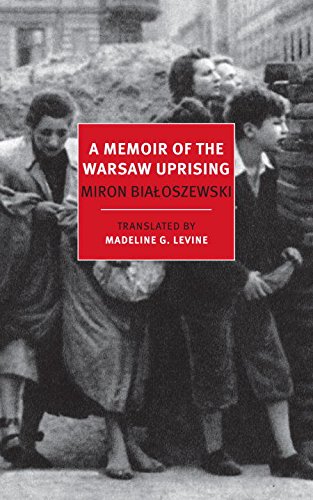
A Memoir of the Warsaw Uprising (New York Review Books Classics), by Miron Bialoszewski

Ebook PDF Online A Memoir of the Warsaw Uprising (New York Review Books Classics), by Miron Bialoszewski
On August 1, 1944, Miron Białoszewski, later to gain renown as one of Poland’s most innovative poets, went out to run an errand for his mother and ran into history. With Soviet forces on the outskirts of Warsaw, the Polish capital revolted against five years of Nazi occupation, an uprising that began in a spirit of heroic optimism. Sixty-three days later it came to a tragic end. The Nazis suppressed the insurgents ruthlessly, reducing Warsaw to rubble while slaughtering some 200,000 people, mostly through mass executions. The Red Army simply looked on.Białoszewski’s blow-by-blow account of the uprising brings it alive in all its desperate urgency. Here we are in the shoes of a young man slipping back and forth under German fire, dodging sniper bullets, collapsing with exhaustion, rescuing the wounded, burying the dead. An indispensable and unforgettable act of witness, A Memoir of the Warsaw Uprising is also a major work of literature. Białoszewski writes in short, stabbing, splintered, breathless sentences attuned to “the glaring identity of ‘now.’” His pages are full of a white-knuckled poetry that resists the very destruction it records.Madeline G. Levine has extensively revised her 1977 translation, and passages that were unpublishable in Communist Poland have been restored.
A Memoir of the Warsaw Uprising (New York Review Books Classics), by Miron Bialoszewski- Amazon Sales Rank: #385712 in Books
- Published on: 2015-10-27
- Released on: 2015-10-27
- Original language: English
- Number of items: 1
- Dimensions: 8.01" h x .59" w x 4.99" l, .81 pounds
- Binding: Paperback
- 288 pages
Review "Probably the finest book about the insurrection of 1944. . . . Białoszewski’s book was about the city and its people; in the course of his narration, the two become interchangeable.” —John Carpenter“A Memoir of the Warsaw Uprising is a faithful, antiheroic, and nonpathetic description of disintegration: bombed houses, whole streets, human bodies disintegrate, as do objects of everyday use and human perceptions of the world.” —Czesław Miłosz"In a country in which writers were supposed to uphold the moral conscience, Białoszewski was the opposite, a champion of insignificance…When the moment came, he filled page after page with details about life amid the rubble — about what it was like to pick dust and debris out of one’s soup, to visit a barber, to attend a Chopin concert with guns and bombs going off all around, or to use a latrine…” —Daniel Lazare, Jacobin“A master of grammatical games, puns, and colloquial speech patterns, this dark-minded, philosophically inclined scrutinizer of the humblest objects of daily life is enjoying more popularity and critical attention a quarter century after his death than during his lifetime. Outside of Poland, he remains best known for his Memoir of the Warsaw Uprising.” —The Iowa Review “Białoszewski very quickly emerged, surfaced for me as the most exciting and most intriguing Polish writer of what now would be the second half of the century.” —Chicago Review “Białoszewski demonstrates that each loss also offers a new way of seeing and something new to see, even if what comes into view is only a ‘grey naked hole.’ He manages to generate a new form from absence and emptiness as the ‘greynakedhole’ takes on a life of its own. Seen this way, the world’s inescapable losses generate not only pain, but also creative possibility and even perhaps ‘inexhaustible joy.’ ” —Clare Cavanaugh, Partisan Review “This most ‘private’ author of postwar Polish literature disregards discourses of history so deeply embedded in the Polish literary tradition; rather he focuses on the mundane aspects of the everyday life, usually from an autobiographical perspective and using an overtly colloquial language. Although Białoszewski’s works have stirred many discussions, most of these have focused on his treatment of genres and language.” —Joanna Nizynska, professor of Polish, Harvard University “Poems of Miron Białoszewski is the book I hope to one day hold in my hands. A great post-war Polish poet, Białoszewski wrote work radically different from that of his contemporaries—Miłosz, Świr, Kamieńska, Herbert, and Szymborska—but his poetry was just as powerful and important to the development of the contemporary European lyric.... When I mentioned [him] to Tomaž Šalamun in a recent conversation, Tomaž’s face lit up: ‘Białoszewski, when he is translated and available in English, will cause an explosion in American poetry!’ One hopes so.” —Ilya Kaminsky, poetry editor, Words Without Borders
Language Notes Text: English (translation) Original Language: Polish
About the Author Miron Białoszewski (1922–1983) was born in Warsaw, the son of a postal clerk. During the German occupation of Poland in World War II, he studied Polish literature in an underground school, though he never obtained any kind of degree. Not a combatant, he was deported to a German work camp following the Warsaw Uprising, escaped after a month and, as the war drew to its end, returned to his devastated city. Białoszewski worked as a journalist, writing poetry at night, though it was not until 1956 that his first volume of poetry, Obroty rzeczy (The Revolution of Things), appeared to great acclaim. Additional volumes of poetry and short prose texts followed, while Białoszewski also wrote plays for and acted with the collaborative and experimental Tarczyńska Street Theater. A Memoir of the Warsaw Uprising came out in 1970.Madeline G. Levine is Kenan Professor of Slavic Literatures Emerita at the University of North Carolina, Chapel Hill. Her translations from the Polish include The Woman from Hamburg and Other True Stories by Hanna Krall, Bread for the Departed by Bogdan Wojdowski, four volumes of prose by Czesław Miłosz including Beginning with My Streets: Essays and Recollections and Miłosz’s ABC’s, and a new English version of the collected stories of Bruno Schulz (forthcoming).

Where to Download A Memoir of the Warsaw Uprising (New York Review Books Classics), by Miron Bialoszewski
Most helpful customer reviews
6 of 7 people found the following review helpful. A Personal Account of the Warsaw Uprising By Jan Peczkis This was originally written in Polish in 1970. Owing to the fact that the author uses somewhat unorganized narrative, the reader of this book may find it difficult to follow it. There is, however, a helpful glossary (pp. 233-234) of Polish-related allusions.Bialoszewski commonly compares the carnage of the Uprising with that of the original German siege of Warsaw in September 1939. For instance: "When on one day--the 23rd, I think--18,000 shells fell on Warsaw. September 25--that was the decisive day--from morning to night, for twelve hours, Warsaw was bombarded." (p. 80).In common with many authors describing the Warsaw Uprising, Bialoszewski elaborates on the deadly weapons which the Germans had--and against which the Poles had no defense. This includes the Nebelwerfer ("roaring cow", "bellowing cow", "wardrobe", etc.). He comments: "I saw apartment houses which had been uprooted by the `cows', narrow ones, but sometimes four stories high." (pp. 164-165). There were also the giant German artillery pieces: "The `berthas' were the worst. They were, as far as I can remember, three-quarter ton bombs. Three quarters of a ton isn't too bad. Only it was three quarters of a ton of bomb, and straight from the sky, at a slant. I think that was the decisive factor...I'm talking only about the toll among the cellars." (p. 165)Bialoszewski also discusses the evacuation of Warsaw following the capitulation of the Uprising on October 2, 1944. There was astonishment that so many civilians were still alive.In 1946, after the Uprising and the war itself, Bialoszewski personally observed the cremated remains of tens of thousands of Polish civilians who had been murdered by the Germans and their collaborators at Wola (p. 35)
0 of 0 people found the following review helpful. Warsaw Ghetto Uprising: Chaos and Loss By dolgag The book is a stirring montage of chaos, destruction, fear, and camaraderie.It is to be skimmed for full effect. There is no real pretense of precise chronology;. and that's a good thing. A swirling nightmarish experience has left the young man's head spinning with events.Some of the most touching scenes are of churches and nunneries and monasteries destroyed, but not before they pitched in to help their fellow Poles --even an order of nuns never before outside the convent walls. The images are vivid. It will become a film.
4 of 9 people found the following review helpful. No heros, just poeple trying to survive By A Customer Warsaw Uprising from civilians point of view. Everytrhing is in constatnt motion. Simply great
See all 3 customer reviews... A Memoir of the Warsaw Uprising (New York Review Books Classics), by Miron BialoszewskiA Memoir of the Warsaw Uprising (New York Review Books Classics), by Miron Bialoszewski PDF
A Memoir of the Warsaw Uprising (New York Review Books Classics), by Miron Bialoszewski iBooks
A Memoir of the Warsaw Uprising (New York Review Books Classics), by Miron Bialoszewski ePub
A Memoir of the Warsaw Uprising (New York Review Books Classics), by Miron Bialoszewski rtf
A Memoir of the Warsaw Uprising (New York Review Books Classics), by Miron Bialoszewski AZW
A Memoir of the Warsaw Uprising (New York Review Books Classics), by Miron Bialoszewski Kindle

Tidak ada komentar:
Posting Komentar