Emerging from Turbulence: Boeing and Stories of the American Workplace Today, by Leon Grunberg, Sarah Moore
Get the link to download this Emerging From Turbulence: Boeing And Stories Of The American Workplace Today, By Leon Grunberg, Sarah Moore and begin downloading. You can desire the download soft data of guide Emerging From Turbulence: Boeing And Stories Of The American Workplace Today, By Leon Grunberg, Sarah Moore by going through various other activities. And that's all done. Currently, your count on review a book is not constantly taking and bring guide Emerging From Turbulence: Boeing And Stories Of The American Workplace Today, By Leon Grunberg, Sarah Moore anywhere you go. You can conserve the soft data in your gadget that will never ever be far and read it as you such as. It resembles reading story tale from your gadget then. Currently, begin to like reading Emerging From Turbulence: Boeing And Stories Of The American Workplace Today, By Leon Grunberg, Sarah Moore and get your brand-new life!
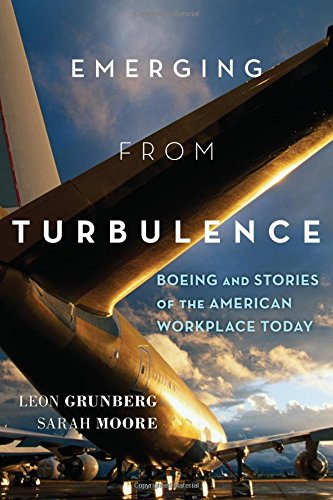
Emerging from Turbulence: Boeing and Stories of the American Workplace Today, by Leon Grunberg, Sarah Moore

Free Ebook PDF Online Emerging from Turbulence: Boeing and Stories of the American Workplace Today, by Leon Grunberg, Sarah Moore
The book looks at workers in three stages of their careers—early career, midcareer, and retirement—sheds light on generational differences in the workplace, and addresses issues such as job training and work moving overseas. Long-time employees reminisce fondly about the family and engineering culture of Heritage Boeing and many are sad and angry about the new, financially driven ethos brought in by the McDonnell Douglas executives after the merger. Newer, younger employees, with no direct memory of Heritage Boeing and more individualistic attitudes, accommodate themselves more easily to the new Boeing. Employees past and present talk about the exciting challenges of launching new, breakthrough airplanes such as the 777, the thrill they feel when the airplanes they produced take to the skies, and the wrong-headed decisions that plagued the disastrous early development of the 787. The narratives also reveal how workers balance work and home life, navigate changing gender relations, and strive to find meaning in this transformed workplace culture.Emerging from Turbulence takes readers inside these profound workplace changes and shows both the personal and the national impact of today’s realities.
Emerging from Turbulence: Boeing and Stories of the American Workplace Today, by Leon Grunberg, Sarah Moore- Amazon Sales Rank: #298763 in Books
- Published on: 2015-10-15
- Original language: English
- Number of items: 1
- Dimensions: 9.32" h x .80" w x 6.26" l, 1.02 pounds
- Binding: Hardcover
- 206 pages
Review Grunberg and Moore—professors of comparative sociology and psychology, respectively—[present an] . . . insightful . . . book based on their two decades of research into Boeing's corporate culture. They emphasize changes that have occurred since 1997, when Boeing merged with another aerospace giant, McDonnell Douglas, and shifted from focusing on being a 'great engineering firm' to minimizing risk, pleasing shareholders, and achieving profits. The 'Boeing family' was no more; employees were told by the new president to 'quit behaving like a family and become more like a team. If you don't perform, you don't stay on the team.' The authors set out to chronicle this sweeping shift in one company's social contract using personal narratives from past and current employees, categorizing them by the timing and duration of their employ. Sub-categories include 'No Longer Family,' 'I Work to Live,' and 'Not What I Expected.' The workers'-eye-view is valuable. (Publishers Weekly)Boeing executives eager to inspire an engaged workforce might want to set aside their management books to study closely this account of what their employees think and feel. (The Seattle Times)Boeing's changes, sparked by a merger with rival McDonnell Douglas, included the relocation of work to cheaper places, the outsourcing of key components and aggressive cost cuts. These details, and conclusions drawn from them, form the basis of Emerging from Turbulence. . . .[Grunberg's] study . . . goes far beyond Boeing. It provides a view over two decades of the unwinding of the postwar social contract – where workers felt they could rely on decent pay and benefits in exchange for hard work. (Financial Times)Emerging from Turbulence offers compelling documentation of the unfolding effects of contemporary workplace transformations. In the tradition of Studs Terkel’s Working, the stories captured here resonate well beyond the iconic Boeing Company. This timely contribution will prompt serious reflection about what to expect of the workplace of the future. (Linda Smircich, Isenberg School of Management, University of Massachusetts)An elegant, carefully crafted book, Emerging from Turbulence portrays the depth and scope of self-worth that people draw from the social relations and respect that they find at work. However, by comparing workers with different lengths of service, Grunberg and Moore document notably different changes in orientations toward work and the self when a ‘family’ company eliminates its community fabric and becomes a honed instrument of capitalism contributing to the increasingly stratified distribution of wealth in America. The book offers a comprehensive sense of how employees facing such change turn inward in seeking senses of personal value. (Paul M. Roman, Regents' Professor of Sociology, Owens Institute for Behavioral Research, University of Georgia)Emerging from Turbulence provides a voice for employees of Boeing following its merger with McDonnell Douglas in 1997. This book represents an example of what many employees across the country have gone through with such transitions to more lean production and how that transformation is experienced from the eyes and words of the employees. Grunberg and Moore are brave in depicting the psychological downfalls of transitioning from an employee-oriented company to a profit-focused company, but, more than anything, the book chronicles the impact of mergers and outsourcing on declines in employee commitment and loyalty, and represents how many US workplaces have moved towards more instrumental relationships with their workers. (Leslie B. Hammer, Portland State University)
About the Author Leon Grunberg is professor emeritus of sociology, University of Puget Sound. Sarah Moore is chair and professor of psychology, University of Puget Sound. Together they are the authors of Turbulence: Boeing and the State of American Workers and Managers.

Where to Download Emerging from Turbulence: Boeing and Stories of the American Workplace Today, by Leon Grunberg, Sarah Moore
Most helpful customer reviews
6 of 6 people found the following review helpful. The Human Story When High Tech Work is Commoditized By SS50 Boeing employees feel accomplishment when their products succeed in the marketplace. As employees, they understand that aerospace products are complex, heavily engineered, and must meet high standards for quality and performance. "Emerging from Turbulence" captures those sentiments in a series of interviews, in the context of a major culture shift in leadership by executives.In the old culture, the leadership message emphasized problem-solving, quality, and productivity.In the new culture, workers are all interchangeable and work is a commodity - available anywhere on demand. Cost cutting and wishful thinking stand in the way of performance. The culture takes initiative away from workers. The result was a slow-motion train wreck on the 787 program.Ask Boeing employees, "What was the best program you worked on - and what was the worst?" For many, the 777 was the best. It was the last program in the old engineering problem-solving culture. The catch-phrase on the 777 program was "Working Together." That sentiment and that leadership message was baked into the 777 program. You hear that experience in the book's interviews.The worst program in recent memory was the 787. It's catchphrases are also heard in the book's interviews - "Be a team player; do what you're told, or we'll get someone who can."Around the time of the culture shift, a Boeing executive was asked, "Do you value loyalty?" He answered, "Of Course. I'll take all the loyalty I can get. But I won't pay a nickel for it!""Emerging From Turbulence" is the human-scale story of how that leadership new message comes across to employees.The authors frame this as social contract or psychological contract at work. Fair enough. To Boeing employees, the ultimate test of an idea is "Does it work?" In an engineering work culture, design and manufacturing employees are inclined to accept decisions that sacrifice their own interests, to some extent, if they believe the program will benefit overall. If decisions put both the employee and the program at risk, you get a very different reaction.Thousands of manufacturing employees at Boeing and other companies have lived this experience. For them, the interviews in this book will be real, immediate and familiar.
2 of 2 people found the following review helpful. The merger with McDonnell Douglas saddled Boeing with upper managers who had only cared about quarterly profits and looking good By Mark A As a 34 year Boeing employee, the last 15 working Technical Manuals in Boeing Commercial Airplanes and a respondent to the surveys that are the basis of this book, I can verify that the office environment created by Boeing upper management was exactly as described in the book's individual narratives. Our jetliner reputation was based in large part on technical superiority and a respect for our customer support. Airliners are very complex and it takes years to learn the subtleties of how different systems interact and the differences of customer options to become an expert in timely support to an airline with a problem and a scheduled departure. CEO Jim McNerney was not schooled in jetliner technical culture and didn't want to learn. The merger with McDonnell Douglas saddled Boeing with upper managers who had only cared about quarterly profits and looking good to Wall Street, eventually running the McDAC airliner business into the ground by refusing to spend money on R&D. When the 787 Program was conceived, these managers saw a way to off-load the cost of engineering and employees to numerous partners, some who had never handled such large projects. This might have worked if Boeing upper management had put in place rigorous, knowledgeable oversight to catch the problems that resulted early, but they deliberately did not. When huge challenges and totally partner failures became obvious, they told the employees "Everything is fine, let us deal with this". Many credible, data-based efforts were made to convince Boeing management of the impending debacle and they were all rebuffed. The result was a textbook case of large project mismanagement, huge cost overruns and customer anger. As the crisis unfolded, management lied that outsourcing was not the problem and tried to pin the whole thing on the unionized aircraft manufacturing and office personnel. The final result was Boeing management decided to try to save money by moving almost the entire Customer Support Division to Southern California to strip off union representation and cut wages. When few Seattle area employees volunteered to take the major compensation reductions and retired or found jobs in other divisions around Seattle, Boeing was forced to start almost completely over to rebuild this group from ex-McDAC employees that did not know Boeing engineering or products and new hires from college. A good read of the personal experiences of Boeing Commercial Airplanes employees with varied views of this period in Boeing history.
1 of 1 people found the following review helpful. "Working Together" has changed to "Make Money, or Else" By Shelby's Dad As a retired Boeing Employee, I found this book interesting reading, though it more or less confirmed what I felt upon leaving the company 10 years ago. It was a wonderful company to work for and the stories and memories of amazing aircraft will be no more, I suspect. Why Boeing elected to merge with a failing company and then give him a high-level position at Boeing may go down as one of the worst business decisions ever made. Hiring a Jack Welch (GE CEO) understudy in Mcnerney who is perhaps best associated with the manufacturing of "Post-it" notes at 3M, was hardly the type of person we needed to run a legendary aircraft and aerospace company. I almost wish we'd been able to follow Alan Mulally to Ford. Alan was not only a true leader and great team builder, he was also a brilliant Engineer. His move to Ford was a crushing blow to Heritage Boeing IMO and I wish the authors had made more mention of Alan and the effect on his move vis-a-vis the merger.I suppose though, that as a retiree, the "new" Boeing with emphasis on profits is maybe the right answer to keep my pension checks coming. The observations made by the authors regarding the younger work force and their expectations are probably shared by young people coming into the workforce everywhere. Not just Boeing. I just wonder how many of them at Boeing will rush out to the flightline to watch the first flight of a new airplane? I'll bet few of them will have tears in their eyes the way we did when the company took so much pride in what they were producing. Maybe they'll get 3M tissue Post-its.The book was accurate in my estimation. I wish somehow they captured even more of the emotions and feeling of loss many of us felt toward "our" company and the discard of "Family and Team". Can you imagine delivering the B-17 three years late?
See all 7 customer reviews... Emerging from Turbulence: Boeing and Stories of the American Workplace Today, by Leon Grunberg, Sarah MooreEmerging from Turbulence: Boeing and Stories of the American Workplace Today, by Leon Grunberg, Sarah Moore PDF
Emerging from Turbulence: Boeing and Stories of the American Workplace Today, by Leon Grunberg, Sarah Moore iBooks
Emerging from Turbulence: Boeing and Stories of the American Workplace Today, by Leon Grunberg, Sarah Moore ePub
Emerging from Turbulence: Boeing and Stories of the American Workplace Today, by Leon Grunberg, Sarah Moore rtf
Emerging from Turbulence: Boeing and Stories of the American Workplace Today, by Leon Grunberg, Sarah Moore AZW
Emerging from Turbulence: Boeing and Stories of the American Workplace Today, by Leon Grunberg, Sarah Moore Kindle

Tidak ada komentar:
Posting Komentar